Reviewed by Ian Hamilton
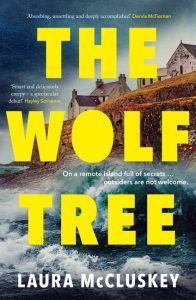
A remote island is obviously a place of isolation and the vulnerability that such isolation can induce. Laura McCluskey sets her novel on the island of Eilean Eader, located in the harsh Atlantic Ocean west of mainland Scotland. It is portrayed as a cold and forbidding place where the inhabitants focus in on themselves with consequent suspicion of outsiders. Just as William Golding explored the relationship between the norms of civil behaviour and errant human nature in an isolated setting (The Lord of the Flies), so too does McCluskey in The Wolf Tree.
Two detective Inspectors are sent to the island to confirm that the death of a young man, Alan Ferguson, was suicide. McCluskey uses third person narration (a potentially omniscient authorial voice) to take us into the thoughts and actions of the two police officers, named DI Georgina (George) Lennox and DI Richard Stewart. We spend much more time over the shoulder and in the mind of George but her intensity is counterbalanced by Richie’s greater experience in the job and calmer demeanour. Frequently we are reminded that George has recently made poor decisions during a raid, which led to her, and the villain, falling from a balcony to the cobbled street below. As a result of this, she is now suffering chronic pain and mental anguish. Richie is concerned she is becoming addicted to opioid pain killers. Presumably this “back story” is included to invite the reader to see George as a real and complex character.
There are two hundred and six residents on the island and the reader is introduced to a quite a few of them. One needs to be attentive or risk confusing, MacLeods, MacNeils, MacGills and MacKinnons. As the narrative proceeds, Kathy MacKinnon, Cecily and Donald Campbell, John MacLeod and Fr Ross prove central to the plot.
Alan Ferguson killed himself by throwing himself off the lighthouse catwalk and that building plays a key role in the second enigma which confronts the two detectives because in 1918 the three lighthouse keepers disappeared, and it is still not clear how or why. George is given their logs to read and becomes deeply curious about this, much older, case.
All these things are revealed skilfully by the author. She exercises stylistic restraint and economy of phrasing. Her dialogue is crisp and credible. Those talents ensure that the reader happily continues to turn the page. In the early sections of the novel, there is just enough intrigue – the howling, the wolf face at the window, the sense of secrets held – to feed the readers’ curiosity without swamping them with too much inexplicability.
Perhaps those words of commendation may need to be tempered, as the final sections of the story might be criticised by some as overly dramatic. Readers who relish Gothic style will remain happy readers to the last page, those for whom the Gothic flourishes diminish their enjoyment will still admire the structure and impact of the story without necessarily being convinced by the drama of the denouement. Even so, it would be unfair to judge the way the story is resolved as unbelievable, as the author’s control of characterisation remains steadfast and her observations about human morality are sadly astute.
In this context, the role of Fr Ross is important. Eader was too “small fry” to warrant the attention of Protestant reformers and, as a consequence, it remained Catholic. Father Ross’ very authoritarian view of belief and ritual co-exists with remnant Gaelic superstitions. The author may have sought to alert us to this via the existence of a double spiral over the islanders’ doorways. Certainly, within a thriller-mystery this book insightfully explores the double spiral of human behaviour capable of good and evil.
The Wolf Tree
[2025]
by Laura McCluskey
Harper Collins
ISBN 978 146076 557 5
$34.99; 346pp