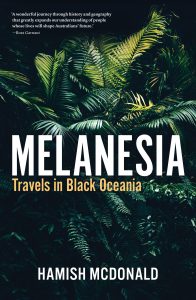
Reviewed by Norrie Sanders
Melanesia, for many of us, is an area we have heard of but would struggle to define, let alone understand its cultures and peoples. Some of the countries and locations are very familiar, but often because of conflict or controversy. Civil unrest in the Solomon Islands, rebel fighting on Bougainville, riots in New Caledonia, corruption in Papua New Guinea and military coups in Fiji, to name a few. They also harbour tropical paradises that lure tourists to western style resorts on short vacations.
Australian journalist Hamish McDonald has made many trips over the years and his most recent set of journeys has resulted in this book. The trip spanned several of the island nations and he strove to travel by land and sea as much as possible, perhaps in deference to the main travel modes of most islanders. The result is an amalgam of travelogue, potted history, individual stories and characters, cultural traits and political intrigues.
He has that old fashioned journalist’s eye for objectivity and the writing is not judgmental, though his selection of facts and characters makes plain where his heart lies. For the reader, this translates to a great deal of new and interesting information, that sheds a positive, though never sycophantic, light on the indigenous peoples as well as newer settlers.
In these highland places especially, Papuans had developed an agricultural economy long before those of Mesopotamia or the Indus plain. And [through a traditional song] …. they are revealed as men and women, as people, who knew, love, and exulted in it [p285].
The same cannot be said of most of the politicians – both white and black – who make appearances. The list of poor decisions, bias, corruption and outright crimes is a long one. Yet there is an interesting analysis of the way that some politicians see the western concept of “corruption” as ignorance of cultural customs in which those with power and means are obliged to share with family and allies.
Throughout the book, the legacy of colonialism looms dark. This is not so much black armband stuff, but Hamish’s assessment of how the past has shaped the present. It is not just about exploitation by the European powers, but of invasion by the Japanese in WW2, labour procurement, armed intervention and questionable governance by Australia (John Howard’s deputy sheriff) and more recent Chinese economic interventions. Issues like independence from colonial rule and even secession within countries are alive and unresolved.
As a near neighbour, Australian elites still tend to patronise, rather than listen:
Australian conservatives assume that islanders share our historical fear of invasion and would feel reassured by the presence of warships from the same navies that used to bombard their villages. Australian progressives assume that islanders share their liberal views on gender fluidity, same sex marriage and formal religion [p.295].
The treatment of each country is quite different. It’s hard to know whether this is an accident of Hamish’s journey, who he meets and where he visits, or a deliberate intent to deal with each of the diverse countries differently. To cover the enormous geographic and cultural diversities within and between countries would require a set of encyclopaedias.
An unusual book because of its multiple styles, but a fascinating one. It has something for everyone and there is enough detail to be a very useful primer for a region that deserves greater attention.
Hamish McDonald is an award-winning Australian journalist. He has been correspondent and foreign editor for The Sydney Morning Herald and the Far Eastern Economic Review, reporting from the Pacific Islands, Indonesia, Japan, Hong Kong, New Delhi and Beijing as well as around Australia.
Melanesia Travels in Black Oceania
(March 2025)
by Hamish McDonald
Black Inc.
ISBN: 9781760642037
$36.99 (Paperback); 336pp