Reviewed by Ian Lipke
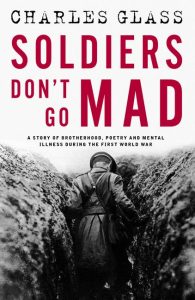
Readers might be forgiven for wondering what Charles Glass was thinking of when he named his book Soldiers Don’t Go Mad. However, clarification is not needed for readers familiar with Siegfried Sassoon’s works, readers who would recognize the poet’s
and it’s been proved that soldiers don’t go mad
unless they lose control of ugly thoughts
that drive them out to jabber among the trees.
This book has a number of foci. It reveals information, hitherto unrealised today, about the war experiences of Max Plowman, Wilfred Owen and Siegfried Sassoon. It examines the place in wartime of an unwritten alliance between the poetry of the war depicting the jingoistic literature of early war times with new metaphors for the agonies of the trenches. Owen and Sassoon, in particular, show a powerful shared sensibility that can be traced over a relatively short period of time. Apart from the biography of these two men, the book captures the environment of Craiglockhart and its dynamic treatment of its clients.
A critic, named Kofsky, comments that Don’t Go Mad is a moving elegy on the power of art to express the inexpressible. This book is about expressing the inexpressible. Not only is it a chronicle of the patients, and the doctors who sought to overcome shell shock during World War One, but it also demonstrates the resilience of the human spirit. The book captures the openness that was forged between those caught up in the obscenity of war together with the trauma experienced by those who would help them.
It is difficult to cease rolling out the praises for this book. First, it provides a thorough examination of at least two war poets, Owen and Sassoon, from the points of view of their respective writings but also supplies equal treasure in the narratives of their biographies. The author spends considerable attention on the soldier-poet Max Plowman, sufficient to explore his reputation, but not as detailed as we find with the two ‘superstars’. This coverage reflects truthfully the place in history each soldier-poet commanded.
Wilfred Owen’s war poetry on the horrors of the trenches and gas warfare was much influenced by his mentor Siegfried Sassoon and stood in contrast to the public perception of war at the time and to the confidently patriotic verse written by earlier war poets such as Rupert Brooke. Among Owen’s best-known works – most of which were published posthumously – are “Dulce et Decorum est”, “Insensibility”, “Anthem for Doomed Youth”, “Futility”, “Spring Offensive” and “Strange Meeting”. Wilfred Owen lived until five days before the armistice in 1918.
Such a pen picture leaves out far more than it includes. This lack is met more than adequately by the ‘Go Mad’ publication released by Charles Glass. An example of the depth to which Glass contributes is the death of Owen in a humble creek, the Sambre-Oise Canal in France (Glass, 272). Subsequent to the description of his death is the haunting tale of Owen’s body appearing in a chair to Sassoon and holding a conversation with him, before simply disappearing (273ff).
Sassoon is not forgotten among these tales of ‘strange’ happenings. He won a Military Cross for valorous conduct. Sassoon’s poetry both described the horrors of the trenches and satirized the patriotic pretensions of those who, in his view, were responsible for a jingoism-fuelled war. Sassoon became a focal point for dissent within the armed forces when he made a lone protest against the continuation of the war with his “Soldier’s Declaration” of July 1917. As a result, he was sent to the Craiglockhart War Hospital. It was at this institution, at this time, that the friendship between Owen and Sassoon was fostered and grown.
Glass’s book provides much information that was until now unknown. As revealing as the biographical interests of the main players, is the story of the real impact on numerous ‘hurt’ soldiers of Craiglockhart and its personnel. A marvellous book indeed.
Soldiers Don’t go Mad
(2025)
by Charles Glass
Bedford Square Publishers
ISBN:978-1-83501-017-4
S24.99;352pp