Reviewed by Patricia Simms-Reeve
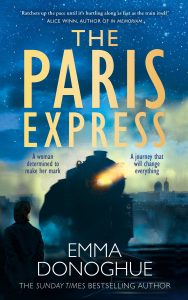
In two of her very successful previous works, Emma Donoghue created situations in enclosed scenarios which were riveting to read. The Paris Express too is a masterful example of stories of a group of people brought together; this time for a few hours for the train journey from Granville, in Normandy, to Paris.
The express is carrying a random selection of French society in the year 1895. Carriages reflect the status of their occupants. The first class is spacious and luxurious, with fine cuisine. Three members of parliament travel in this comfort, while in second class the passengers are more crowded, sustained by more limited facilities. Third class Is crowded, with uncomfortable bench seating, cold and smelly. One of the women is forced to give birth there before she arrives in the City.
Petty dramas and conversations unfold but one passenger is identified early on as an anarchist, Mado, determined to strike a blow for the revolution. She carries a lunch box containing a homemade bomb. Squeezed into a third-class compartment, she intends to detonate it as the express reaches Montparnasse, hoping to kill some members of the wealthy elite in first class, in the carriage behind.
This fact runs a current of suspense, right to the very end. The tension increases when the very practical Russian, Blonska, realises what the innocuous lunch box must contain. She is alert to a chance that might prevent disaster, but Mado is vigilant.
This gripping aspect of the book is neatly paced by glimpses of various other characters on the train, some historically true, others imagined. This is a clever technique that adds to the interest roused; and amongst the scientists, artists, writers, engineers, parliamentarians, mothers with children, is Bienvenue, the father of the modern Metro.
The steam engine itself is given detailed descriptions of function, speed and complexity. It becomes a character, almost, as it responds to the control of Guillaume, the driver, and Victor, the fireman. Their friendship highlights the demands their occupations dictate. It excludes a life beyond speed and steam.
This express, no. 721, really did race from Granville to Paris and crashed in 1895. An old photograph from the time inspired Emma Donoghue to pursue exhaustive research into the incident and the result is a book that is both a fascinating thriller and a social history of ‘fin de siècle’ France. The rigid class divisions, the disgruntled worker, the spirit of revolution protesting the inequalities, over a century later echo the French society’s unrest which today has the added complication of immigration.
It is highly unusual for a steam engine to be such a prominent ‘character’ in a novel, but the wondrous feat of engineering that it represents for me was one of the most interesting and enjoyable aspects of The Paris Express. Together with the snapshots of French society gathered together for this particular journey, it provides a tense and thrilling ride on this dash through the French countryside on the brink of a new century.
The Paris Express
[2025]
by Emma Donoghue
Picador
ISBN: 978 1 03505 7 276
$34.99; 288pp