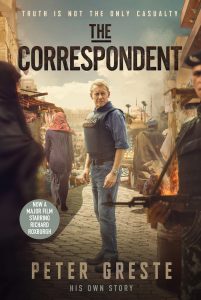
Reviewed by Norrie Sanders
Journalists are prolific story tellers. Their profession is demanding and stress is no stranger. But that can go to another level when they become the story. Particularly when that story involves incarceration in a foreign jail. Working for an Arab news service, Peter Greste suddenly went from relative obscurity in Australia to a figure of international renown following his arrest after just a few weeks in Egypt.
He and two al Jazeera colleagues were imprisoned for more than a year on fabricated terrorist charges, before public pressure and diplomacy finally saw him released. His colleagues were later pardoned, but he remains a convicted criminal under Egyptian law. This book is a re-badged edition of The First Casualty (2017), to coincide with the release of a feature film – both of which are called The Correspondent (2025). Early in the book he tells us that: One of the most seductive reasons for becoming a reporter is the privilege of having a ringside seat to history [p51]. Ironically, in this book he is in the ring.
The central narrative is of his arrest and imprisonment, interspersed with chapters on his earlier experiences as a foreign journalist in Afghanistan and Somalia. The irony is not lost that he was not arrested in either of those relatively lawless places, but in the self-styled democracy of Egypt. There are also several chapters on the main theme of the book – media freedom. It is a powerful message drawing on the experiences of other journalists across the world, as well as, of course, his own loss of freedom.
A short epilogue was added in 2025 that concludes that journalists are being arrested in increasing numbers and he cites the Gaza conflict as a recent example of journalistic suppression by military and political force.
Reading this book reinforces my impression that Peter Greste is a man of courage and of principle. He provides strong evidence that objective journalism is increasingly seen as bias by many regimes around the world. When journalists fear to report all sides of a story, propaganda is the result.
I realised that our experience was part of a….. more obscure conflict between journalist and belligerents on both sides of what has become known euphemistically as the ‘War on Terror’ [pxv].
We are no longer simply witnesses to the struggle. We are, by definition, a means by which the war itself is waged [p54].
This theme alone makes the book compelling reading. But Peter’s own journey through the Egyptian prison and judicial system, the inmates he meets, his relationship to his colleagues and most of all, his own thoughts and feelings, is powerfully articulated.
After talking it over with Alaa, [a fellow political prisoner] I suddenly realise something fundamental. This has nothing to do with us and everything to do with press freedom. It is not about anything we have done but about what we represent; it is about intimidating every journalist working in Egypt [p85].
[Note: in January 2025, Peter spent three weeks on hunger strike in support of Alaa, who helped Peter overcome some of his darkest days in prison].
Professor Peter Greste is an award-winning foreign correspondent who spent 25 years working for the BBC, Reuters and Al Jazeera in some of the world’s most volatile places. From Afghanistan to Latin American, Africa and the Middle East, he reported from the frontlines and beyond, although he is best known for becoming a headline himself, when he and two of his colleagues were arrested in Cairo while working for Al Jazeera and charged with terrorism offences. He has since become a vocal campaigner and advocate for media freedom…….. Peter is Executive Director of the advocacy group Alliance for Journalists’ Freedom and Professor of Journalism at Macquarie University.
by Peter Greste
(April 2025)
UQP
ISBN: 9780702269141
$36.99 (Paperback); 368pp