Reviewed by Ian Lipke
When an author begins a book with a very provocative statement as this writer does with Whisky Valley, s/he needs to be clear that her book is a companion piece, and that the second will continue with the same level of charge as the first. Sauers’s first novel, called Echo Lake, is a gripping tale of mystery in which the heroine Rose McHugh veered close to death at the hands of a trusted friend. The scream which introduces the second volume is the link between the two books, and it is likely that some readers will find in it the peak of excitement.
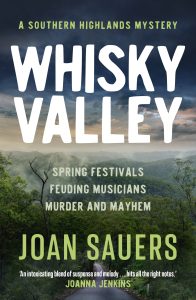
Whisky Valley introduces world famous violinist Billy Mak whom we find trundling around the countryside with a ten-million-dollar violin. Billy is a visitor to the Southern Highlands who plans to join a quartet in playing at the local music festival. Then, would you believe it, he fails to meet his commitment to his hosts – he goes missing. Subsequently, after the greatest floods in living memory have receded, his body, sans violin, is discovered, murdered.
Rose McHugh’s son is one of Billy’s closest friends. It follows, in Rose’s peculiar logic, that the police must immediately suspect him of involvement in the murder. No evidence is supplied to explain why she would take this view. No shortage of other suspects exists, in fact a few of them would happily wish Billy dead. Floodwaters play their part in making the lives of the Sothern Highlanders difficult. Flooding is so prominent as to maintain characterhood unto itself.
A concentration on narrative alone does not do justice to the writer’s work. Her strength lies in a related field, not so much in whodunnit literature but rather in the beautifully detailed explorations into human relationships. The author writes with finesse when she explores relationships between friends, spouses, lovers and siblings, and in her explorations in that minefield, between parent and adult child.
The whodunnit aspect of novel writing can show an involvement with human relationships. It is not as though the reader is called upon to cast his mind too far out of the cognitive domain. It is all a matter of degree. If the writer is skilful enough, she can take sidesteps into history and incorporate into her novel sound excursions into historical events. Whisky Valley has a few historical side steps with Rose looking into the history of the local distillery located near an old tar pit. Yet another deviation from the main plot comes when Rose hears a first-hand account about the perils of do-it-yourself DNA testing. Because these issues are not allowed to exercise domination over the story, the author succeeds in introducing this matter. She is on firmer ground when she writes about the making, repairing and storing extraordinarily valuable musical instruments.
This book has numerous different layers, sidesteps and subplots. Some are more relevant to the writer’s purpose; others have no place at all. The book is of sufficient appeal to keep certain readers involved. Personally, I require something more hardcore. Let the blood flow!
Whisky Valley
(2025)
by Joan Sauers
Allen & Unwin
ISBN:978-1-76147-134-6
$32.99;384pp