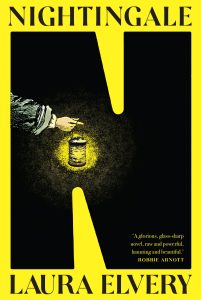
Reviewed by Wendy Lipke
Laura Elvery has been the recipient of awards for her short stories and was given a Varuna Residential Fellowship to write this novel. Throughout the work there is evidence of thorough research but because so much is already known about the famous “Lady of the Lamp”, Florence Nightingale, a new angle had to be found for yet another novel on this legend’s life.
In this latest book the reader is introduced to Florence, not at the beginning of her life, but at the very end when her eyesight had failed and doubt is placed on the soundness of her mind. She is ninety years old and as the author points out this is a great achievement for the early years of the 20th Century. She is looked after by a young woman, Mabel, and late at night they have a visit from a young man, called Silas Bradley, who has a heart-felt plea for his hostess – “Miss Nightingale? Please listen. What did Jean do to me?” (80). The search for this answer is the theme throughout this story.
The narrative is provided through the perspective of three key characters. There is Florence Nightingale herself, a serious, fearful child until she worked that fear out of her system. The life that emerged was a forceful one where her hands did the work, her mind made a path for many others to follow, and her legs took her halfway round the world to experience things that others could not imagine. But she did bring about change.
Silas Bradley was a soldier who met Florence and a small group of women on their way to the Crimea. They met in Marseilles and here one of Florence’s group forged a closer relationship with him. ‘Ah, (he) thought. Here’s a soul like mine, a soul who doesn’t quite fit’. (33). Her name was Jean. Each of these three seem different from their peers. Both Florence and Jean were considered odd as they were interested in what the surgeons were doing and liked to watch operations. It is these three who share their experiences with the reader.
The writing is jerky in parts when an errant thought slides into the memory. Yet this seems to fit perfectly with the personality of the narrator. I also found some of the verbs quite unusual in their situation. ‘The lawn at the back of the house yawns out towards the river’ (37). The reader is given graphic and detailed descriptions about society in the early 1900s as well as the results of the fighting and the conditions under which all those involved worked.
People of the time did not know how to feel about the work these women were doing. A daughter who doesn’t marry is considered peculiar at that time; Florence Nightingale was a very religious woman and believed that this was what she was meant to do. History has shown that she had a very important part to play during her lifetime which was long and productive yet towards the end became very lonely.
Laura Elvery is a writer from Brisbane, and this is her first novel. She has a PhD in Creative Writing and Literary Studies. Her work has been published in Overland, Griffith Review, Meanjin, Kill Your Darlings, Island and The Big Issue. Although strange in many ways this story was interesting to read. I am still thinking about the epilogue.
Nightingale
(2025)
by Laura Elvery
UQP
ISBN:978-0-7022-6587-7
$32.99;240pp