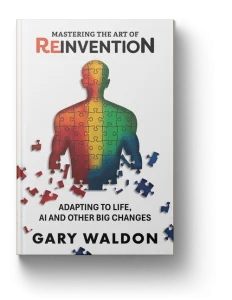
Reviewed by Ian Lipke
Gary Waldon, author of best seller Sort Your Sh!t Out, is back to help you Master the Art of Reinvention at a time when we need it the most. Life is always changing, but big changes like relationships, work, winning lotto, or even the rise of AI can disrupt everything, whether we like it or not.
Mastering the Art of Reinvention delivers a humorous, vulnerable, and practical insight into human resilience to help you:
* Grab the steering wheel of life and reinvent yourself like a pro.
* Turn life’s curveballs into growth opportunities you can’t miss.
* Get ready for AI changes and plan how to make it work for you.
* Create a mindset that keeps you adaptable and moving forward, always.
* Unlock your true potential and build the life that actually matches your dreams (and values).
Change is inevitable, but reinvention should be intentional. We have numerous opportunities to cope with change. We can either do nothing i.e. pretending nothing has happened, approach the change with some reluctance, or seize the change with enthusiasm and make the best of the hand we’ve been given. In his chapter Holy Crap, Waldon identifies blindsiders (changes we don’t see in advance), forecasters (consequences may not change but we have time to prepare ourselves), pressure cookers (when insignificant things build to a rage), ostrich (when the catalyst is so confronting we ignore it), a thrillseeker (who goes actively looking for change). He then proceeds in subsequent chapters to identify influences on change. Unfortunately, the author succumbs (if only briefly) to repetition of material already dealt with. This is the curse that tends to abide with books of this kind.
I find it quaint that under the heading ‘flexibility’ he praises his situation as someone who has held forty-three jobs (and been married twice), calling his situation adaptable. He claims that flexibility is the ability to explore options and refocus when the need or opportunity arises. By contrast, resilience is the trait that determines whether you can keep going when things are looking grim. Fortunately, Waldon argues that unmet expectations are not necessarily failures, that the monsters we create in our heads are often much bigger, badder and scarier than those we encounter in the real world.
Waldon’s chapter on AI is, to employ the cliché, a breath of fresh air. Readers must not assume that the first 50+ pages have been difficult to read and comprehend. Waldon is a very easy writer, easy to read, easy to understand. AI has the attraction of newness, of novelty describing what we all want to know.
Preceded by the agrarian revolution, the industrial revolution, and the digital revolution AI is occurring in our time and has all the characteristics of a major generational change. A huge plus for Waldon’s book is his identification of jobs and industries likely to be impacted by AI. At this early stage, Waldon identifies them as transportation, healthcare, finance, the knowledge industries and technology. Waldon concludes the AI chapter with an assurance that while some may fall, others will rise. It is not all gloom ‘neath the clouds ahead.
The remainder of Parts 1 and 2 presents segments as interesting as the early parts but tend to be less valuable. Individual entries caught my interest. The steps in the Kon Mari method were obviously not original but were absolutely appropriate to most people’s needs. I would never have thought of tidying by category, rather than location. Stage 3: Empower Yourself suggests a number of activities. It would be overly simplistic to suggest that the items recommended have been mentioned in publications by numerous predecessors, but there is a look of familiarity about them. Such does not detract from their value; at the very least they remind us of suitable activities. Besides, they offer a freshness not often seen. Moreover, the issues of mentorship are given new exposure and this is valuable.
This book continues to churn out new thoughts for readers to consider, from snippets to much longer entries. They are all there. What fun it must have been to write. Highly recommended.
Mastering the Art of Reinvention
(2025)
by Gary Waldon
Do Good Sh!t Publishing
ISBN:978-0-6488320-2-7
$32.95; 222pp