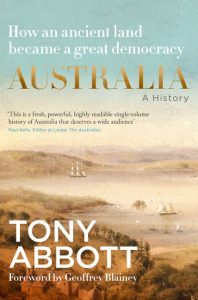
Reviewed by Ian Lipke
I found the initial chapters of Tony Abbott’s new book bracing and balanced, comprehensive within limits and a jolly good read. I was all too familiar with the author’s political philosophies and his blind acceptance of Roman Catholicism. I even found myself warming to him as I worked my way patiently through the book; I found myself supporting his views – and that had to be a first for me. I should have known it would not last.
Abbott’s view of colonial times is benign. He pens a picture of William Wilberforce and the anti-slavery movement in encouraging terms, while, naturally enough, depicting slavery in dire terms. In Abbott’s view colonisation by the British was a stroke of good fortune. “It was not uncommon for a raiding party to kill the first Aboriginal person they spotted,” he acknowledges. If one considers some of the alternative occupying powers, we could have had it much worse. Abbott meets head-on that injustice was levied on the First Nations people, even to identifying some of the interactions with whites as murder. Yet his treatment of men such as Bennelong may have been too lenient. The pendulum can be swung too far.
I expected to be reading an ultra-conservative publication, with reference material from the right-wing press and a Foreword by Peta Credlin in her most fulminating style. Not so. An item on frontier violence is as likely to cite a left-wing journal as much as any publication. Abbott’s account of the convict era is likely to cite the conservative John Hirst, who is well known for writing with favour on the subject.
What follows is, in the words of Frank Bongiorno, “a mainly celebratory account of Australia’s relentless progress towards an egalitarian democracy” where opportunity lies available for all and class distinction hardly exists. This is the Tony Abbott I expected. One would have to have the blindness of a successful politician to suggest these features of Australian life. The author gains some sense of perspective when describing institutions and policies – tariff protection, compulsory arbitration and the living wage for example – but he soon branches to a discussion of individual effort and private enterprise.
Having reached the discussion in the book where Bob Hawke, Gough Whitlam and John Howard hold centre stage, we become aware of a major change in the character of the book. There can be no coincidence in the fact that the book loses its current style in favour of one that rests on Abbott’s opinion as a statesman. This is not to argue that the arguments are not politics based. His comments on Pauline Hanson just cannot be ignored. Abbott draws a distinction between the conservatism of Hanson which “mistrusts change and instinctively resists it, and Howard’s “that respects what is and wants the future to reflect the best aspects of the past.”
Abbott has always been a Howard man. He supports Howard, but manages to retain a more or less balanced viewpoint until he discusses his contemporaries Kevin Rudd, Julia Gillard, and his successors Malcolm Turnbull and Scott Morrison. No longer do we find an even-handed treatment of issues, nor is there non-partisanship. Abbott provides a spirited defence of his own government. But he seems eager to come to grips with Turnbull and to score off him where possible. Abbott has little time for Morrison but it more gentle with him largely because of AUKUS.
Without being unrestrained in his criticism, it is true to argue with Abbott that we are a nation going downhill. He cites our policies of over-the-top Covid restrictions, excessive immigration and tolerance of unintegrated migrants. With attention being paid by the Federal Government to that Abbott anathema, the indigenous voice, and, amazingly, no mention of State governments in Abbott’s book, one is left puzzled over where Abbott’s role now lies.
Australia – A History
(2025)
by Tony Abbott
Harper Collins
ISBN: 978-1-4607-6829-7
$49.99; 450pp