Reviewed by Wendy Lipke
Stolen Man on Stolen Land is written in the first person and follows a young Afro American couple who have decided to spend some years in Australia. The reader is given an insight into life in America for people of this culture and how others, not born in Australia, find life here. This book is both a documentary and a comment on race relations, generated through personal experience.
Tyree Barnette and his wife both have a good education which allows them to find work easily in Australia. The first sixty pages of the book describe the reaction of friends and neighbours to the couple’s decision to emigrate as they congregate at the local barbershop. They all offer advice, although their source of knowledge appears to have come from song lyrics, movies or the internet. They have not learned yet that Hollywood stuffs up one’s image of reality. The various flights the young couple experience within America and on to Australia are described in detail.
On arriving in Sydney, they mix with people from a variety of cultures and are pleasantly surprised by the friendly inclusivity they experience. They had believed that being ‘black’ meant that they were bound to catch hell wherever they went (52). They soon discovered that there was a more diverse population in this new location than Australia exported to the world. They enjoy a life of restaurants, art shows and parties until they discover they are to become parents then they move to a nearby suburb.
It is interesting to encounter the difficulty some people have with pronouncing Australian place names and the confusion generated by our penchant for abbreviating words. Even though Australia and America are both English-speaking countries what is highlighted in this book is some of the different meanings given to certain words.
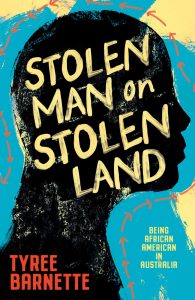
Although the book’s cover suggests that it might be about Australia’s First Nation Peoples, I did not find this to be the main thrust of the book, although comparisons are made between the dark-skinned people in both countries. An interesting fact I learned was that 60,000 years before colonialisation there is evidence of some Aboriginal people having blonde hair (74).
Tyree Barnette’s book does promote Australia’s multiculturalism and explores privilege and race within this policy. This couple were interested in exploring the array of Blackness that they were being exposed to. Being in Australia afforded them the opportunity to visit other countries nearby with different cultures and comparisons are made with their own earlier experiences. They soon discover that in their homeland racial progress moves more as a shuffle (154) when compared to experiences elsewhere.
Through the experiences of this couple, watching from a distance as their homeland, the USA, transforms through the rise of Trump and the Black Lives Matter Movement, Tyree and his wife have learned both the unique joy and pain of migration.
This is an easy book to read and the experiences of this couple highlight, I believe, more of America’s treatment of people with black skin-colour than that in Australia.
Tyree Barnette, the author of this book, still lives in Sydney and his family has grown now to embrace two boys. He works in student services at Western Sydney University. Tyree is also a member of the Sweatshop Literacy Movement and has written several papers for publication.
Stolen Man on Stolen Land
(2026)
by Tyree Barnette
Affirm Press
ISBN: 978 1 9230 4658 0
$36.99; 320pp