Reviewed by Wendy Lipke
Steven Carroll first wrote about a Detective Sergeant Stephen Minter in his novel, Goodnight, Vivienne, Goodnight. This character was the son of Austrian Jews who were detained in England as enemy aliens and tragically died while interned. Now, he reappears in The Afterlife of Harry Playford, where he has a greater role to play.
It may be of interest to the reader to know that the name Playford was in fact, the name of a well-known politician in South Australia’s early history and that Queenscliff, Victoria, where this story is set, is just across the water from where Australia’s seventeenth Prime Minister, Harold Holt, went for a swim and was never seen again.
Steven Carroll’s latest story, The Afterlife of Harry Playford, begins with a pile of clothing, neatly folded on the beach, which was never retrieved by its owner. A man had been seen going into the water earlier in the day. Later the reader learns that the missing man was a politician by the name of Harry Playford, who appeared to be well liked and respected by his colleagues.
The year is 1951, and the beginning of an organisation known as ASIO. According to this book, Australia was not in a good place at that time regarding its relations with other countries, because past experiences had resulted in information landing in the wrong hands. Trust was at a very low ebb.
Steven Minter and his partner, Brigid Delaney, have been lured to Australia, and this location, after seeing a painting in a shop in England. Now they are questioning their being here – ‘All pictures make impossible promises’ (13) and ‘promises are only half delivered’ (30). Yet when they leave again it was with unexpected regret.
Brigid is ‘on loan’ to put together a team of code breakers, while trying to discover the leak in the system. But she is finding it hard to know whom to trust. The description of Australia at this time is not a very complimentary one. Nobody seems to want to be here. Much seems to be made of the fact that Steven and Brigid are English, ‘ten-pound Poms’.
When the clothes are found on the beach, this becomes a police investigation, and Steven is the man in charge. Yet throughout the story, because of his knowledge and interests, people often ask him, ‘Are you sure you’re a copper? The story unfolds in three parts. The mystery of the pile of clothes on the beach is the focus until it is discovered who the missing man is, then he becomes the focus. He is a well-known politician and has been seen as the next main candidate for Australia’s top job.
This story and the style in which it is written is by someone who has thought long and hard about life, about the world, and how to engage with it. And how to live in it. Just like the description given to one of the characters so important to the story being told. There is a lot of analysis and introspection, and the mystery of Harry Playford starts to feel like a painting built around optical illusions often leading back into themselves. The inclusion of an artist, who painted the picture which led to Steven and Brigid coming to Australia, his recollection of what he saw on the morning of the incident of the pile of clothes, and the artist at Montmartre, Paris, all link to this impression.
The story begins with the location, on the beach with its lighthouse and the Rip and that is where the story also ends with no resolution. However, by now the reader has the hint of what might have happened in this police case.
Many questions are asked in the telling of this story and information revealed about Australia in the early 1950s. The influence of the Yanks during the war, when everything was for sale and Melbourne was forced to grow up before its time is revealed, as well as the political climate of that time. There is a sense of aloofness always present.
Although I felt that there was a certain amount of repetition in content, especially at the beginning of the chapters, I did enjoy some of the descriptions and feelings that accompanied the words on the page. It was interesting to think of a railway station like the front door to a town, everything comes out through it in the morning and goes back in when day is done.
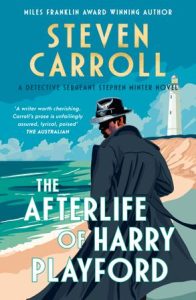
This is an unusual book. The cover gives the feeling that it might be a simple detective story. There is nothing simple about the way the story is told. At times it seems like the author is involved in a deep philosophical discussion about life and the way people see things. However, looking back on what I have read, I found this book to be very thought provoking and felt the storyline of the missing politician to be satisfactorily presented.
The Afterlife of Harry Playford
(2026)
by Steven Carroll
Fourth Estate Harper Collins
ISBN:978-1-4607-6459-6
$34.99; 304pp