Reviewed by Wendy Lipke
Empires of Violence is the work of a team of highly skilled researchers who have collaborated in the production of a book that is well balanced and which meets the market at a time when it is most needed.
For simplicity the authors have chosen to speak of the original settlers of a land as Indigenous people. For those who took possession of land already occupied, the words settler, occupier and invader have been used. This practice refers, in particular, to the Europeans who went to live on non-European lands.
The text covers foreign settlement of South Africa, North America, the penal colony of New South Wales and compares these times with that of revolt and rebellion in French occupied Europe from around 1780 to 1820. The authors spell out their belief that revolution does not merely happen. There must be a set of circumstances in a world that is considering extreme reaction leading to revolt.
It was believed by the originators of this book that the comparison drawn here would help understand the different cultural assumptions, as well as European conceptions of killing and conquest on the one hand, and the Indigenous and local responses on the other (2).
During this time murder, massacre and violence were the means used to forge new states, new political ideologies and new empires. Though these diverse areas may not seem to have much in common, they do explain what was happening in the world during this time.
This is the first time researchers specializing in four different regions and four different histories have come together pooling their knowledge and expertise to find any connectedness. The core of the book looks at case studies within the four regions.
Evidence of the vast research necessary for such an undertaking can be found at the back of the book in the ninety-nine pages of notes, bibliography, and index.
The provision of an Epilogue is not new but is appropriate. This is an attempt to draw together some general conclusions about massacre and violence in the four regions, pointing out commonalities regarding the type of violence and the way Indigenous and local communities resisted the colonial encounter.
Massacres were not new but at this time in history, there appears to be a new kind of war. There was an evident desire to annihilate whole peoples in the name of an idea. Moreover, people were required to comply with new norms through violence.
Throughout the text can be found maps and black and white pictures (Figures) representing the period concerned. Before the Introduction the reader will find A Note on the Use of Names. In the Acknowledgements section, which is at the front of the book, homage is paid to Lyndall Ryan, one of the authors, who after the manuscript was submitted to the publisher, succumbed to her battle with cancer.
The text in the eight chapters of information is well-spaced on the page with appropriate paragraphing and bold titled subheadings. Each chapter begins a third of the way down the page with the first one third carrying the title in larger bold font.
This is not just a history of events in these different parts of the globe in a specific time period. It is more of a probe into the influences and beliefs at the time which resulted in particular actions.
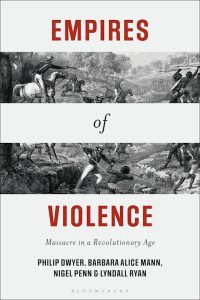
Empires of Violence: Massacre in a Revolutionary Age
(2026)
by Philip Dwyer, Barbara Alice Mann, Nigel Penn & Lyndall Ryan
Bloomsbury
ISBN:978-1-350-53863-4
$34.99; 322pp