Reviewed by Rod McLary
Gary Lonesborough is an award-winning author of YA novels – The Boy from the Mish and I’m Not Really Here – which address issues of self-identity, sexuality and cultural identity among Aboriginal youth. To a fair extent, the novels reflect the personal experiences of the author who grew up ‘as part of large and proud Aboriginal family’ on the Far South Coast of NSW; and this lived experience adds an enhanced authenticity to his writing.
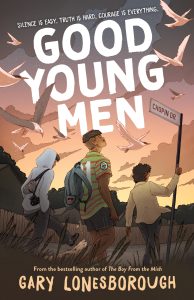
Good Young Men continues in that vein and focuses on the growing-up of four young Aboriginal boys in the small coastal town of Carraway’s Point as they navigate their futures and the simmering racial tension in the township. Kallum, Jordan, Brandon and Dylan grew up together but at high school different interests led them in different directions.
The story is told through the individual voices of the boys and set out in sections headed by the boy’s name. This allows the opportunity for the reader to hear both the inner and outer voices of each boy and how he connects with those in his immediate world – whether family, friends or teachers.
Kallum – on a football scholarship at a private school in Sydney – finds himself expelled and sent back to Carraway’s Point. Jordan – or Jordy – whose mother has died is taking on a parental role with his young sister as his father turns to alcohol to deal with his grief. And his boyfriend Eric has yet to come out as gay. Dylan – the dark horse – was the only witness to the shooting death of Brandon by a white police officer whose trial is approaching. But each has dreams of his future. Although Kallum’s father sees Kallum as attaining football glory with the Rabbitohs and thus compensating for his own failure in that regard, Kallum dreams of work as a park ranger. Jordy has his sights set on acting school in Sydney and Dylan film school.
The boys’ personal journeys towards their futures are clouded by the increasing racial tensions in the town as the trial approaches. In a very frightening way, Dylan is physically threatened by the police officer’s friends and bluntly told that, if the officer goes to gaol, then Dylan will be buried alive along with Jordy. And amidst all this, the boys are navigating their final year at school, end of year exams, school camp and the complexities of teenage life.
One of the strengths of the novel is the very real friendship between the boys and their ready acceptance of each other’s sexuality and relationships. In a heart-warming moment between Kallum and Jordy, Jordy says ‘I place my hand on Kallum’s knee, gently, like it’s a helicopter landing safely to ground. … I think for a moment I have done the wrong thing, but then Kallum covers my hand with his, trembling. I never thought I’d feel Kallum’s hand over mine’ [113].
There are a number of such moments – full of tenderness and meaning – which suggest to the reader that the boys will have positive and fulfilling lives ahead of them. One hopes so.
Gary Lonesborough has crafted a YA novel which confronts with sensitivity and authenticity deeply personal issues which face many young readers but especially those who are Aboriginal as it addresses racial and cultural bias, sexuality, coming out – and the very human need for a place in the world.
Well recommended to all readers especially those in their teenage years.
Good Young Men
[2026]
by Gary Lonesborough
Allen and Unwin
ISBN: 978 1 7611 8217 4
$22.99; 293pp