Reviewed by Norrie Sanders
Reading other peoples’ letters without their permission is probably a violation of modern privacy laws, but for those of us who enjoy that sort of thing, Postscript permits us to pry without guilt.
The National Library of Australia holds millions of letters in its collections….by eminent and everyday Australians, [that] tell the story of the nation by telling the stories of millions of individual moments [p iv].
The letters we finally selected, which span almost 200 years, are not necessarily the most famous or life-changing or emotional. What they do each contain is something human and real …. that gives us a sense of our own history [p v].
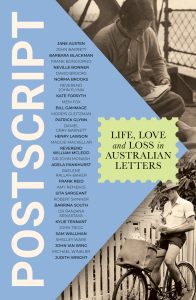
For each of the letters from the historical collection, contemporary authors were invited to select one and pen a response of their own. All 33 letter writers are listed on the cover. The (unnamed) editors have chosen to keep the volume slim and many of the letters are less than a page.
There were many pleasant surprises and highlights, and a few are set out below in no particular order. Some of the most famous writers are, like many of us, mired in the banal: alcoholic Henry Lawson, whilst drying out in rural Australia, sends a shopping list of writing materials and other instructions to his publisher. Others are inspiring: suffragette Adela Pankhurst (Emmeline’s daughter) affirms that going to gaol for her cause was absolutely the right thing to do. Similarly inspiring was indigenous senator Neville Bonner, revered by his correspondent as a statesman who changed history.
Being privy to exchanges between famous people who are friends is a window seldom opened. The delightful comedic interplay between children’s authors Mem Fox and Morris Gleitzman is adults at play. The esteem held by Bill Gammage for historian Manning Clark is palpable, but he still managed to provide a critique of Clark’s most famous publication, all within a single paragraph.
An inspiring tale was the teenage Chinese boy – yet to fully master English – who in 1956 made a suggestion to the Melbourne Games committee that forever changed the face of the Olympics.
Another pleasant surprise was the contemporary authors. Their letters were written for a different purpose and were more complete stories. Just three standouts in a strong field were: Michael Winkler’s letter to his sons; Amy Remeikis’ critique of women’s standing in the modern world; and Dr Ranjana Srivastava’s letter to a former cancer patient’s daughter.
A thought provoking, funny and fascinating compilation.
Postscript: Life, Love and Loss in Australian Letters
by “Various”
(May 2026)
NLA Publishing
ISBN: 978 1 9225 0774 7
$26.99 (Paperback); 122pp