Reviewed by Norrie Sanders
A history of Scotland is as much about its contribution to the world as about the events that took place within its borders. Scottish people, places and innovations are familiar: where would the world be without whisky, Loch Lomond, bagpipes, chloroform, Robbie Burns and Adam Smith? A constant stream of emigration from Scotland means that many countries promote Scots culture and Scottish DNA is a part of many of us.
But what of Scotland itself? Is it a country, a region, a nation or a common culture? We know of its highlands and lowlands, but what about its relationship with England and all those surrounding places – Norway, Ireland, France and the Netherlands, to name a few. How did a collection of tribes dating from the Neolithic come together to form a common identity?
Early Roman and Viking incursions never achieved dominance. That honour was left to Scotland’s most persistent foe – the English. Battles over the border lands have been common and Scotland for many centuries was allied to France – with strong military and economic ties to Europe that are reflected to this day.
The Anglo-Scottish relationship has been a roller coaster since a unified Scotland emerged around 900. After centuries of skirmishes, the Scottish/English border was finally settled in 1237. England took over (at least in the South) in 1298, yet the efforts of Robert the Bruce delivered independence just 30 years later. The balance fluctuated for several centuries, with periods of autonomy coming with strings attached: Effectively Scotland was being treated as a foreign state, but not permitted to act like one [p120]. Since the Act of Union in 1707, Scotland has been the subordinate, with fluctuating levels of self-governance and quasi-independence into modern times.
The challenge of writing in the Shortest History series is to weave a coherent narrative from 10,000 years of human habitation, without resorting to a dumbed down version that rehashes well-known material.
Murray Pittock succeeds in this challenge – he draws several threads through the complex tribal and ethnic history of ancient Scotland, that are largely unbroken throughout history. Some of the most famous events such as the battle of Culloden and the highland clearances are briefly mentioned within the context of the wider circumstances that frame them. A second thread is the strong relationship to Europe, which links to the long-established immigration from surrounding countries, balanced by the emigration of Scots seeking their fortune.
The result is a very readable history that does not shirk from the complexities of a nation-state that has been shaped by external forces and a populace determined to punch above its weight.
Murray Pittock is Scotland’s leading cultural historian. His books include Culloden, Enlightenment in a Smart City, The Myth of the Jacobite Clans and Robert Burns in Global Culture.
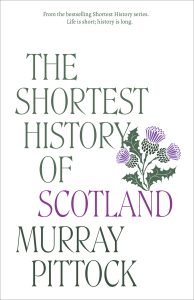
The Shortest History of Scotland
by Murray Pittock
(May 2026)
Black Inc Publishing
ISBN: 978 1 7606 4535 9
$27.99 (Paperback); 224pp