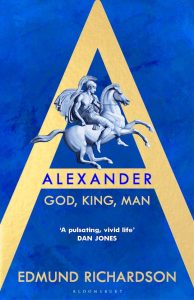
Reviewed by Patricia Simms-Reeve
Whether wishing to learn of the vivid life of one of history’s greatest figures or appreciating the brilliant scholarship involved in bringing this to the reader, Edmund Richardson’s biography of the legendary Macedonian/Greek is enormously satisfying and thrilling to read. Thousands of versions of Alexander have been scattered around the world. Continually changing, ‘The Legend of Alexander’ disseminated his exploits for over 1,000 years after his death. Richardson’s masterly portrayal of this inspirational figure excludes imaginative ramblings. It is a brilliant depiction of his subject, the result of years of work and research of recently discovered material.
Facts not only trace his wonderfully heroic 32 years but bring an exciting reality to life in that region of the world. A feast could involve gigantic quantities: 300 sheep, 400 cattle and 50 pounds of garlic were some ingredients.
Following his defeat of the King, Darius 3rd, in the battle of Issus in 333BCE, he acquired 29 musically gifted women, 40 flower-arrangers, 46 chefs and 40 perfume mixers! Pot-watching was another exclusive occupation in Darius’ court….
Alexander’s father, Philip 2nd’s court was a humble one; but it boasted Greek intellectuals – philosophers, scientists and writers. One of his many wives, Olympias, was Alexander’s mother. Hephaestion, childhood friend was his lifelong companion and lover. The ill-tempered huge chestnut stallion, Bucephalus, accompanied him throughout his life. Such was the devastation when each died, that a massive monument was built to the horse and, in later years, after deep mourning, the most elaborate funeral conducted for his friend.
Upon the assassination of Philip in 336 BCE, Alexander became King and thus began the years of battle acquiring lands that extended far beyond the previously known world. Accompanied by magicians and soothsayers, he fought Darius, the King, at Issus. After Issus, there were great sieges, the city of Tyre, then Gaza. Capturing Tyre involved a brilliant innovation using fire ships. The people of Tyre bravely resisted by employing the fiercely torturous burning sand to defend their walls but eventually to no avail. Alexander’s army butchered children and 2,000 others and 30,000 were forced into slavery. The king himself was seriously wounded. Blood poured from an arrow lodged in his shoulder.
Alexander was determined to carry on despite excruciating pain. The army marched to Egypt and was once more victorious. He became its Pharaoh in 332BCE. Here, history saw his greatest achievements. The great Library of Alexandria was founded and stands today as perhaps the world’s finest. It was. ‘a marketplace for the mind’, the greatest centre of learning the world had ever seen.
Above the city he built one of the seven wonders of the ancient world, the lighthouse of Pharos. A marvel of technology and engineering, it stood for over 1,000 years.
He was regarded as part Greek, part Egyptian and in Alexandria, the wealth and knowledge of three continents, Africa, Asia and Europe combined.
‘No great mind can exist without a vein of madness’ stated Aristotle and Alexander had evidence of this. His was a complex character, capable of demonic energy and determination. At times his slaughtering was cruel and relentless. Yet he was egregiously generous and a devoted friend who in turn inspired deepest loyalty.
Many believed him to be driven by ‘Telauges’, a Greek word for a distant light which is a guide in the darkness.
He led his army to Susa and the delights of Persian cuisine but the stark contrast of the crossing of the Gedrosian desert killed half his men and they experienced the terror of a flash flood in a desert. Loyalty wavered as they were overcome by starvation and thirst. It was almost 12 months later that they had a proper meal.
Nine years of warfare won Alexander an empire greater than any which previously existed. He found the glories of India, employed three different translators to understand the wonders of this new and exciting country with its fabulous wealth, teeming rains, clouds of insect life and highly trained elephants. Its wealth was immense but in Afghanistan, the picture changed. Opium and hemp cast their spell, and the harsh mountains were a near insurmountable challenge.
However, it was the glorious city of Babylon that cast a spell upon the Greeks. The greatest city the world had ever known, Babylonians had invented the plough 10,000 years before. They refined cuneiform, invented the wheel. One of their astronomers had shown the earth revolves around the sun. Using 60 as a base is due to the brilliant Babylonians.
They were justly proud of their safe and advanced water system operating from 1750 BCE. Alexander’s army, in their ignorance, polluted this and inadvertently were responsible for the death of their king. He had suffered several serious wounds including a punctured lung during the previous years, but it was drinking the water that brought him an agonising death. Edmund Richardson describes what took place upon Alexander’s death in fine detail. His body was stored in a vat of honey, then embalmed. The coffin and hearse were solid gold and even the 64 mules pulling it had golden crowns.
One man, even Alexander, could not govern and control such a sprawling empire. Brilliantly brave as a leader, he lacked the ability to plan future administration of the disparate group of countries. His army was aging, and suffered profound psychological distress having endured years of the heightened intensity of fear and the conditions of war.
One word describes Alexander for the Greeks: Thaumastos’. It conveys wonder, astonishment, fascination but also confusion and sadness. A miracle might be ‘thaumastos’ or a god, or a trick. Alexander was impossible to explain.
Alexander was a subject which involves a plethora of diverse events, ideas, and staggering achievements against hitherto insurmountable odds. Attempting his biography is something only an academic of Edmund Richardson’s calibre could possibly accomplish with such flair and scholarship. Not only this, but he has produced a work devoted to one of history’s greatest men, flawed, diminished in his ability to contribute to his conquered peoples’ lives, but an indefatigable soldier and inspirational leader. This dazzling and erudite biography is irresistible to any reader interested in learning about Alexander, a brilliant man, an admirable king and to many, a God.
Alexander: God, King, Man
[2026]
by Edmund Richardson
Bloomsbury
ISBN: 978 1 5266 5814 2
$39.99; 480pp