Reviewed by Patricia Simms-Reeve
This fine historical novel begins against the backdrop of the Civil War in China and concludes after the massacre in Tiananmen Square. These tumultuous events, the most significant in recent Chinese history, are a stark contrast to the lives of three women and their families. In turn, they form part of the panorama of a China swiftly undergoing great social change, and this very graphically is reflected in the lives of the three women.
During the Civil War, when Communism triumphed over the Nationalist Army, Ah Xue, ‘Little Plum’ grows up with her hardworking mother. One of her mother’s major tasks is to comb and braid wealthy women’s hair. Ah Xue accompanies her in her work and in humble household chores. She is virtually illiterate and her mother convinces her that words are harbingers of trouble.
‘The husband’ of one employer uses his position to use her for sex and a baby son is born to the young girl, powerless to resist. A Catholic convent takes the little boy when he is one day old.
Mimosa’s family struggles too in the days of the Cultural Revolution. Her days are marked by the fights that erupt between her parents but brightened by the occasional visits to the small farm where her grandparents live and eke out a humble existence. The Cultural Revolution looms and unease rules the countryside.
A woman’s role has altered for Fei, raised as a boy. She continually questions her father’s regarding her as a boy, calling her ‘son’. The ‘one child’ policy is perhaps the reason but never clarified. Nonetheless, Fei is devoted to her father. She loves the long uncomfortable bike rides on the crossbar of his bike!
By 1989, she is in Beijing, studying for a science degree and sharing accommodation with three other girls. Abandoning traditional ways, women may now enjoy more freedom and indulge in choosing clothes and cosmetics. Acquiring enough fabric for one garment made of cheap cotton was a challenge for Mimosa, just a generation before.
Post the Second World War, China underwent a transformation unequalled in history. The CCP effected dramatic change in all aspects of society and in their lives, the three women in Nothing to my Name reflect this. Ah Xue lived as so many had for centuries in simple quiet obscurity but by the turn of the 20th century, in a span of just over fifty years, women’s role was unrecognisable in comparison. University education, independence, freedom to choose pathways were now possible for them to pursue.
The author, Kangkang Li Kovacs, is herself a beneficiary of the new place women may hold in Chinese society. Growing up in Nanchang, she now lives and works in the USA. Before writing this, her first novel, she has gained a PHD in Nuclear Physics, and taught Maths and Physics at University level. In writing this book she has produced a tribute to women, family, and the dramatic changes that occurred in such a relatively brief timespan in China. Millions were raised from harsh poverty to enjoy life in modern society.
The book itself skilfully weaves the background of social change unparalleled in history with the lives of the three women. This is portrayed in language that explores trauma, familial love, and striving for stability in chaotic times. At times poetic, remarkably balanced, and unflinching, it is a tale of survival by ordinary women and her own background and talent as a writer, means Kangkang Li Kovacs has produced a book both highly significant and memorable.
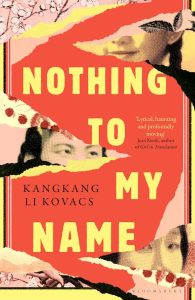
Nothing to My Name
[2026]
by Kangkang Li Kovacs
Bloomsbury
ISBN: 978 1 5266 8728 9
$34.99; 386pp