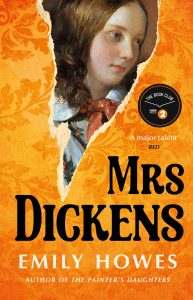
Reviewed by Patricia Simms-Reeve
The intricacies of a Victorian marriage are beautifully created in Emily Howes’s book devoted to the frequently overlooked Mrs Dickens. It is the result of extensive research skillfully enhanced by her imagination.
Catherine Hogarth marries the renowned novelist and they enjoyed a delighted happiness, initially, but sadly that did not continue. Kate’s devotion was unwavering, but Dickens, a complex character, could not help but be affected by his fame. He became erratic, demanding, selfish and, at times, cruel. He often sought solace in lengthy night walks across London. There were episodes of lively entertainment, charming surprises and events that eventually led to his becoming a celebrity of international renown.
Emily Howes, in Mrs Dickens, beautifully creates a portrait of mild and gentle Kate surviving a marriage that suppressed her to the degree that she became a compliant soul, bending to Charles’ demands and reluctantly bearing ten children. One little one, Dora, died in infancy, a deep sorrow and a burden she bore quietly and alone. Her plight is recorded without intrusive judgment, increasing its power and sensitivity.
Anne Brown’s, her servant, version of household events is in the first person which cleverly adds a different perspective to lives that were often private in their endurance and for Kate, her suffering. Anne’s life, too, is far from blissful. It is moulded by compromise and her decisions are dictated to by her position as a servant. At certain times she is a staunch ally of Mrs Dickens but Charles thwarts her supportive intentions. She is separated from her mistress, a devastating loss for Kate.
At times, Kate’s position in the supposedly enviable role of wife to one of the most admired and popular of novelists, was heartbreakingly painful. She confesses inwardly that her words come out as ‘thin imitation of her feelings’. She cannot help but excuse his cruelty as an aspect of his ‘greatness’. She is like ‘tinder always waiting for his spark’. Kate’s unrequited love accepts his disregard, his calling her ‘mouse’, and comparing her to a donkey.
However, she does protest loudly his lack of respect, on one shocking occasion. Sadly, this episode only begins his undermining her soundness of mind. Her painful position is described with a quiet reality that is deeply moving, arousing a longing in the reader for her to discover a solution to her predicament.
Georgina, a younger sister, unmarried, and in love with Charles, maintains an un- sympathetic stance and fails to support her sister when she is wronged by him. It threatens to overwhelm Kate.
She is envied by many because she is the wife of the famous Charles Dickens, but Emily Howes has presented a version of Kate’s life which is far from idyllic. Not only does she live in his shadow, but is desperately unhappy. She strives to be a good wife but it goes unnoticed. Motherhood is exhausting even though she is cherished by the children especially the boys. Her pain grows with her husband openly associating with a young actress, Ellen Ternan, young and beautiful. His public at large continued their adoring regard, unsuspecting of the darkness which shadows his private life.
Mrs Dickens is a fine novel for several reasons. It offers a multi-faceted glimpse of a man prominent in Victorian literature, demonstrates that women’s role was often stifled or suppressed, and illustrates that for many, choices were limited particularly the harsh choices forced on the poor. Anne, tragically, was a victim of this, trapped in poverty and its narrow possibilities.
Emily Howes has written this poignant testimony of the wife of Charles Dickens in language and style that conveys a Victorian marriage with sensitivity and grace.
She presents a version of their marriage that is deeply disturbing but presents it in an objective, beautifully realised way. The book shows the private lives and the stark contrast of the public facade, with both Dickens and his unhappy wife. Many instances of this appear, one being the tour in America.
Her novel is deserving of the highest praise and comes with an unqualified recommendation, to be enjoyed for its sympathetic, heartbreaking realisation of Catherine Dickens. She is a personality frequently ignored but should be admired for many reasons, one being her perseverance, stoic and calmly uncomplaining.
Mrs Dickens
[2026]
by Emily Howes
Phoenix
ISBN: 978 1 3996 1084 1
$34.99; 436pp