Reviewed by Wendy Lipke
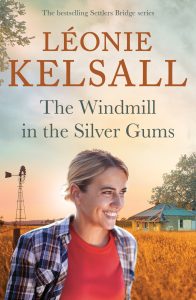
Léonie Kelsall’s latest book is the tenth novel in the Settlers Bridge series. I have read many of the books in this series so was pleased to become reacquainted with some people I had come across before. Each book in the linked series is a standalone and can be read in any order. The author’s love of the country in South Australia shines through in each of her books. Their titles also attest to her strong attachment to the trees in that area.
The Windmill in the Silver Gums highlights another interest of this author, that of Australia’s history. This latest book has two story lines – a modern one and one from the past around the time of the First World War. The earlier story brings to light the prejudice against migrant German families, who had made Australia home. During WW1 Germany was the enemy and although that war was a long way away many Australian people with German connections found themselves in camps where some lost their lives. Sixty-nine South Australian towns with German names were changed during this time. Many family names also followed suit.
This story begins with residents in and around Settlers Bridge banding together to help each other during the shearing period. Here the reader is introduced to Indi Jaensch a girl who loves the land and is determined to show that she can cope no matter what she has to do to stay afloat, especially after her father dies from a farm accident. Here the reader is reintroduced to Lachlan and Hamish MacKenzie whose stories readers of this author will have found in previous books.
In the next chapter the reader is transported to January 1915 where Rose Lehmann, a young woman who is self-centred and impulsive wanting the best from life and the admiration of others, appears. She was looking forward to being emancipated as a married woman, but she did not want to take on any extra work. History was to show her that this was not possible. Her engagement to someone not of her own district was more of an escape from her family and her great adventure. At this stage the reader does not know that this character is related to Indi. As the chapters alternate through the book it becomes clear that Rose is Indi’s great-great-grandmother.
While reading Indi’s story the reader becomes fully aware of the different lifestyles between those who work the land for their survival and those who work for a wage. For those on the land, the days are long and money worries are ever present, and this is before the weather and its impact is taken into account. Yet these people would not consider leaving the land.
Indi, in contrast to Rose, is comfortable in her work clothes. She is very down to earth and often covered in mud. Yet this is Indi’s love story, and she finds her life partner who at first appears so different from herself. Rose’s love story and her life after the war, changed her to become a more likeable person and one who had the strength to hold things together.
I found it interesting to read about equipment for the home which my mother used to use such as Joseph Fowler’s preserving system (169). This was the time that some women banded together to push their own ideas. The Australian Women’s Peace Movement finds a place in this latest novel by Léonie Kelsall.
What shines through these stories set in this area is the willingness of people to help each other even when they have so little themselves. It is the bigger picture for these folk. Through the actions of the key people in this story the author points out that working together can help solve problems that would be insurmountable for an individual. There’s always someone in the crowd who actually enjoys the things you hate.
In the Author’s Note, Kelsall has provided more information about German agoraphobia during World War I, for those interested to find out more about Australia’s war history on home soil.
I always find Leonie Kelsall’s books to be full of human interest and her descriptions, especially in her locations, show a great love of rural Australia. She does not shy away from the harsh reality of life on the land. Her stories are always realistic and relatable.
The Windmill in the Silver Gums.
(2026)
by Léonie Kelsall
Allen & Unwin
ISBN: 978-1-76147-242-8
$34.99; 368pp