Reviewed by Richard Tutin
Some people, especially politicians, sincerely believe that they are kingmakers. They think that they can influence the political situation to not only place their person of interest in the top position but also to gain favours that will enhance their prestige and public image.
Those folk often fail because they do not know how to gain power or wield it effectively. As history shows, the best kingmakers seem to stay in the background while encouraging their preferred candidate to move further into the limelight where they can be seen and heard.
Pamela Churchill Harriman was one of these background dwellers who can rightly claim to be a kingmaker but would strenuously deny that they held power of any sought let alone put people into positions of power where they could, for example, become the President of the United States.
As Sonia Purnell says in this absorbing biography Pamela Churchill Harriman was active during some significant periods of the twentieth century. Her influence began to be noticed during World War II when Sir Winston Churchill used her skills as a hostess to extract information from overseas personnel who were stationed in England as the war progressed. At the time she was married to Churchill’s son Randolf. Though their relationship was under constant strain to say the least, she was on good terms with Sir Winston and Lady Clementine.
Her background and lack of education were often held against her during her lifetime. She was born into an aristocratic family with a relatively low status on the social hierarchy of the time. Her father, Kenelm Digby, preferred to have his daughters educated at home. Initially she lacked social skills when she first began to move in London society. She was though a quick learner and was fortunate to have older women around her who tutored her well.
Purnell reveals that men were attracted to her like flies to the jam jar. She used this attraction to obtain information that Winston Churchill considered necessary for advancing the war effort and, as Prime Minister, be an effective leader during a challenging period in world history.
Churchill Harriman reinvented herself after the war as someone who could open doors and smooth the entry into corridors of power. Purnell has found new information about this and other periods in her life that boosts the ever-growing picture of her influence. Along the way we are shown that she was, at times, insecure and unsure of her skills and ability to form lasting and loving relationships.
When she died in 1997, Pamela Churchill Harriman was a commanding force in American political circles especially when she was appointed as American Ambassador to France. Her passing was mourned by many though, as Purnell, points out there was an equal number of people who celebrated her death.
For those interested in both international and American politics Purnell’s offering is a must read. Churchill Harriman was an extraordinary person who came from a very ordinary background and though she often doubted herself was able to navigate life and extract the best of what she saw and enjoyed.
Sonia Purnell is a biographer and journalist who has written for The Guardian, The Daily Telegraph, and the Sunday Times. Her biography of Virginia Hall: A woman of No Importance: The Untold Story of Viginia Hall, WWII’s Most Dangerous Spy, won the Plutarch Award for Best Biography and was a New York Times bestseller.
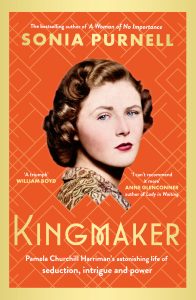
Kingmaker: Pamela Churchill Harriman’s astonishing life of seduction, intrigue and power.
by Sonia Purnell
(2024)
Virago
ISBN: 978 034901 473 9
$34.99; 512pp