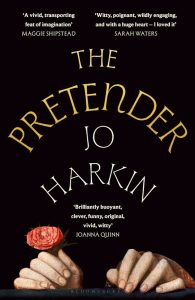
Reviewed by Ian Lipke
Jo Harkin’s hero is depicted at the beginning of the story as a small boy living on a farm where his greatest menace is the village’s devil goat. All is normal behaviour for John Gollan until his life is upended; he is not John Gollan but the son of the long-deceased Duke of Clarence. Several poisonous relatives from the king down to court officials would certainly have wanted to see him dead, if only they’d known of his existence. Once removed from the farm, John travels to Oxford where he undergoes an education suited to a king, learns the rules of etiquette in Burgundy and grasps the machinations of the Court in Ireland. It is here that he meets Joan, surely the most unusual, wilful and intractable heroine to grace English society.
Joan is imbued with extraordinary political savvy, occasional murderous propensities, and manipulative skills that come into play when she demands that John/Lambert display his penis for her appraisal. Commenting that it is too large for her purposes, she casts him aside. This is a temporary situation. She is aware that she must marry or become a nun. Likewise, Lambert must either become king or die in battle. There are no other choices.
This novel presents a take on the life of the Yorkist rebel Simnel (for Jo Harkin’s purposes John, Simnel, Lambert and others) who, after 1487, worked as a spy in the Court of King Henry VII. However, Jo Harkin adds the magic of fiction to create a “gripping, exuberant rollicking picture of British monarchy and life within the Court”.
The storyline takes place over several years, providing Harkin with the task of Simnel’s development as he ages, and begins to increase in intellectual capacity. It would be true to argue that John goes through several internal transformations. These are often incomplete and conflicting, precisely as a boy grows to a man in any society. The author has a great time (I would imagine) playing with themes about identity, belonging, happiness, love, morality, greed, and the need for revenge. The growing increase in Simnel’s attraction to the opposite sex is carefully monitored. Further, Simnel is a very patient character, dealing a devious hand to those who betray him. Harkin lets her imagination loose. She creates her own characters, and the rowdiest of worlds to support them. She develops an intriguing plot with exquisitely profane language.
Harkin’s language requires specific comments. First is the profanity. The book floats on ‘fuck’. The thirteenth-fourteenth centuries could have been a particularly language-obscene age in which case words like ‘fuck’ may have been accepted speech. I don’t have the knowledge of the period to comment on this point. (At one time ‘fuck’ meant ‘to turn the soil’. I don’t think this explanation applies here). It is interesting that all levels of society use the word.
Another point of interest resolves itself around the use of words constructed like ‘astonied’, represented in today’s language by ‘astonished’. A use in the story appears so often that I suspect the author made the conscious decision to deliberately-employ what could have been the ancient form. The question arises, why select only a few words of this form.
This novel is a deliberate deviation from the historical record, but what a powerful diversion. Only a harsh stickler for historical accuracy would find this story wanting.
The book does contain heartache, tragedy, abuse and lies that come to rot and fester. But there are passages that caused me to laugh aloud. A very well placed ‘What. The. Fuck.’ had me in stitches. Many passages exist that begin with a humorous way of servicing the ladies of Court but with repeated use the idea becomes tedious.
An excellent novel.
The Pretender
(2025)
by Jo Harkin
Bloomsbury Publishing
ISBN:978-1-5266-7835-5
$32.99; 464pp