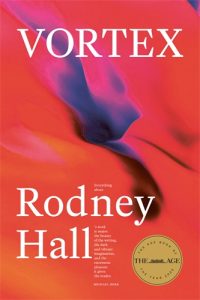
Reviewed by E.B. Heath
A book must be an ice axe to break the sea frozen inside us.
Kafka
Rodney Hall is energizing to read.
Initially, Vortex requires focus. The narrative is fragmented depicting a plethora of characters that pivot from one to another throughout the novel, each with their own plot thread. Unconventionally, chapters begin and end mid-sentence, but take heart, Rodney Hall’s brilliant prose glides readers through the complexities.
In Vortex, rather than employing a linear time frame, Hall has reimagined the novel as a web. The weft of which is formed by the geopolitics of post-World War II. Spies and conspiracies of the Cold War abound. And, as colonialism recedes, brutal factions vying for power compel asylum seekers towards perilous seas.
It is these unfortunate souls from Europe and Asia that populate Vortex. They are a diverse mob. Those with money arrived by air, many survive long harrowing voyages on small leaky boats, where they had no choice but to sit for days and weeks on end and watch … a calm sea sloshing against the hull with reiterative rudderlessness.
Grateful to be safe at last, they are very much tormented by traumatic memories from the past, and, threats from mysterious sources in the present. And, they are aliens in conservative Brisbane of 1954.
Hall has remained true to 1954; there are many references to celebrities and literature from that year, primarily the visit from Queen Elizabeth II, which required a good deal of careful administration conducted by bombastic characters. The Queen’s voyage to her territories takes place aboard the royal yacht Gothic.
She stands at the hub while life alters course around her. The big ship forging out into an empty agitated sea drags forested headland in its wake together with the castles of the past.
Perhaps the main protagonist is sixteen-year-old Compton Gillespie. Although born and bred in Brisbane, he too is an outlier, fatherless and seeking a role model, he is befriended by Beckmann, an ex-German soldier whom he comes to idolise. Compton meets Beckmann as he wonders around The Brisbane Museum: Here in the embedded mortality of stillness, empire his birthright, he is both giant and genius as he circulates through the glorious dusty junk of history.
Beckmann is tough, resilient, his bravery during the German Russian war is the subject of a play by Wolfgang Borchert. He gifts a book entitled The Prose Works of Wolfgang Borchert to Compton, who carries this treasured gift everywhere he goes, along with his dead father’s Voigtlander camera. Oddly, Beckmann is a dancer in a Brisbane night club! (Well, I thought he was going to be a labourer on a building site.) Compton and Beckmann reappear throughout the novel; their friendship keeps readers on edge as to exactly what kind of relationship is developing.
Another possible protagonist is Countess Paloma Rebeca Consuelo a Spanish noble, (a titch stereotypical) who holds court at the Colony Club for the benefit of a group of Brisbane’s migrant population, complete with an enormous diamond ring.
In all other places we are New Australians. But at the Colony Club we can still be European and grateful to be welcome despite the horrid things we have brought with us among our memories.
She is married to the loathsome Claverhouse, Clavers, an amusing caricature of a social climbing English man of the bombastic type. He has been recruited by ASIO, and even spies on his wife.
There are so many characters, some appear only to dissolve into the background, others reappear becoming part of the fabric of the novel, such as Dr. Antal Bródy.
In seven wonderful pages Hall gives an account of Dr. Antal Bródy’s life in Brisbane as he returns home and takes a bath. Readers learn that Dr. Antal Bródy is Hungarian, a regular at the Colony, has a wife and boy, three doctorates (not recognised by the University of Queensland), speaks six languages, and a serious weakness for alcohol, which helps him get through his day selling umbrellas. Bródy is writing a book Language of Imperialism, hoping it will gain him access to academe.
Another wonderfully written character, Russian born Vassily Bogdanovich Hmelnitsky. A vagrant of thirty years, toting his possessions in three plastic bags, he chooses to be a nomadic nonentity to evade Russian spies. He is not a member of the Colony group, although, true to the connectiveness of the ‘web’, there is a later meeting. He ponders his life as he prepares to sleep in a park across from the State Public Library: Soon, with these same bags readjusted to embed him, he will fully stretch out to enter a stratum of yet more merciless clarity concerning who what he has become. And …Romantic ideals such as rule by visionaries – or government on horseback – both so very Russian. Loss of family, loss of place: To escape the Soviet Union he abandoned certainty. And now … An unresolved huddle of regrets hived in bone-memory … toes hoarding toe-knowledge and knees knee-pain, likewise the loinloss of his loins and his empty hole of a heart.
Hall deeply scores into readers consciousness an understanding that many migrants do not just pop jauntily into a new country. There is heavy memory baggage of trauma to carry, impossible to discard.
If Hall accomplishes Kafka’s edict, A book must be an ice axe to break the sea frozen inside us, it is in the last chapter, ‘Coda’. Here Hall describes an escape from death on home soil to possible death at sea.
… Alive to the delirium of starvation. Yet the ocean persists as the greatest beauty of creation. … Then the gigantic night settles again on its bed of waves, the entire ocean held in check by the equilibrium of revolving planets and the long shaky voyage further unravels its length as twisted ligaments.
Readers are taken on a family’s gruelling hardship that ends tragically as many do. Known only as The Guide and his family, he asks: Surely he can’t have drifted off? Stars hail down around his head as a glitter of extinguished fires … he wakes to the terror of something gone wrong.
A web of characters, some stereotypical, others fascinating. All well-written.
Vortex deserves a second and third reading. Readers might wonder does a war ever end, the consequences reach far beyond its dates in the history books.
Rodney Hall is energizing to read.
by Rodney Hall
(2024)
Pan Macmillan Australia
Paperback
ISBN: 978 1 7615 6076 7
$34.99; 464pp