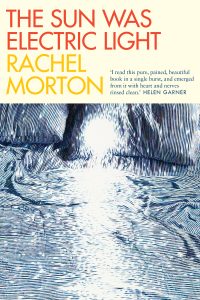
Reviewed by Wendy Lipke
Rachel Morton is the author of the book with a most unusual title, The Sun Was Electric Light. This is her first novel, and it won the 2024 Victorian Premier’s Literary Award for an Unpublished Manuscript. It was also the winner of the 2025 UQP Quentin Bryce Award. This latest award celebrates women’s lives and/or promotes gender equality.
Classics of western literature have imagined the condition of the expatriate as a fugitive, out of place at home and abroad, uninterested in the past or the future, adrift. This story is about such a situation. It is set in Latin America in a small Guatemalan town named Panajachel, on the shores of a vast lake. Ruth is a young woman who leaves her job in New York to visit a place which had given her happy memories ten years ago. For her at present there is only a feeling of blankness, that everything is fake.
This story follows her time there and the people she meets who impact on her life. Firstly, she meets a Swiss sociologist named Emilie before she moves on with her job. They become close but when she leaves it is as if Ruth moves on to others. Ruth comes into the orbit of the beautiful but dysfunctional Carmen and her childhood friend Dwaine who seem to be stuck in the same mire of depression as Ruth. ‘I met Carmen when I wasn’t well and had gone to the lake for the second time’ (1).
The lake plays a dominant role in this story and can be a place of relaxation or have a darker role to play. Carmen believes that it makes people mad, that it contains black magic that sucks you in, holds you there till you go mad then jettisons you out (127).
To create the appropriate mood for the book, the author uses many short simple sentences and at times seems to be unnecessarily stating the obvious. There are detailed descriptions of everyday activities and the ever-changing feelings, and attitudes linked to how the characters fill in their days. The author also personifies inanimate objects as well as providing some unusual similes. An old gardener has a face “like an abandoned church”. A woman is described as suffering in a way “that destroyed you if you got too close”. Always, the environment provides an elemental backdrop: “No matter my mood, the lake was the same. It didn’t see anything as a catastrophe.”
The author uses her characters and their situation to explain what might be going on in the minds of people in the same situation as her protagonists. There is the belief that there are layers to our life and those on top were there because they had to be loosened and blown away (191). Sometimes this layer made us dysfunctional and that is just how things had to be until other layers could come to the top.
One positive fact I did discover was that when one of the group was in a very bad place the others rallied and became stronger and were more focussed through their support. Although the locals and those passing through did not mingle much, the small-town residents were always ready to support those in need, even though they had little themselves.
This is not the type of book I usually read for relaxation, however, I can see how many people in today’s society could feel just like these protagonists, when they cannot see much positivity ahead for them.
The Sun was Electric Light
(2025)
by Rachel Morton
University of Queensland Press (UQP)
ISBN:978-0-7022-6889-2
$34.99; 224pp.