Reviewed by Ian Lipke
Stephen J. Campbell’s reading of Leonardo da Vinci requires the widest possible circulation, not because his argument is utterly convincing but because he comes so close to doing just that. He leaves the reader gasping at the audacity of his proposals but also wondering if he might in fact be right, in so doing turning history on its head.
Only someone with an equivalent amount of the same quality research as Campbell can venture an opinion on the rightness or otherwise of Campbell’s work. The rest of us have to rely on a gut-feeling that his arguments are logical or not but there is much to support him. He is right for example when he states that, “Many…books promise a unique access to the mind of a genius, to the man as he really was, a supreme achiever despite a career thwarted by misunderstanding and adversity, a timeless example”. This is the conventional view of Leonardo.
Almost immediately, Campbell steps into fresh water. While our subject’s achievements were vast, they need to be framed by a life story. “We need the works and the writings to become that story. We want a character somehow like ourselves, still living and breathing at the heart of that complicated legacy. An individual who can reconcile that legacy of achievement, to make sense of it all”. This novel view of Leonardo begins with its base in human desire.
With little delay, Campbell introduces one of his home truths. “The character or personality of Leonardo…serves a purpose – even if that character is largely a fiction, a made-up person created by highly artisan interests after his death, elaborated into a timeless genius in the nineteenth and twentieth centuries, and increasingly made to resemble ourselves in the twenty-first”.
Campbell does not shilly-shally. He calls Leonardo a ‘fiction’ – a largely made-up character in our time. His evidence relies, amongst a host of other things, on the assertion that, despite thousands of pages of notes there is little that can be said with confidence about Leonardo’s life, his character or his personality. Moreover, about one third of Leonardo’s surviving paintings lack records confirming his authorship. Despite contemporaries referring to Leonardo’s charisma and sociable nature there is almost nothing in Leonardo’s own words about the man himself. He was never called Da Vinci until the 1800s. There are claims that scholars should trace DNA or search for fingerprints – Campbell dismisses these with the statement that we would clone him if we could, but fears that the man would become increasingly lost and dispersed in the fog of over-exposure.
The public owns Leonardo but who is it we own? Campbell answers this with a strong argument. His view that criteria for determining the limits of an artist’s work existed only loosely in the lifetime of Leonardo. The notion of the artist as author acting alone is challenged by the conditions of work-shop production and by radically different notions of self-hood, of personal history and identity in the pre-modern world. The history of Leonardo is too often taken to be the story of the solitary mis-understood genius. It is far more meaningful as a history of his encounters and entanglements with a collective of colleagues, followers and assistants, a point of convergence of different currents of thought.
Campbell provides a mountain of discussion with respect to Leonardo per se but considers also how questions of self and identity were conceived by pre-modern individuals and the radical differences from our own conceptions.
The book is beautifully produced, the arguments are scholarly presented, and reader interest remains high throughout. But are his arguments convincing? Yes!
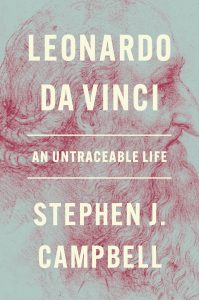
Leonardo da Vinci: An Untraceable Life
(2025)
by Stephen J. Campbell
Princeton University Press
ISBN:978-0-691-19368-7
$65.75; 322pp