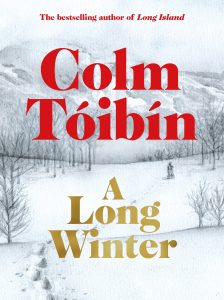
Reviewed by Rod McLary
In his Afterword [p127] to this novella, Colm Tóibín explains that A Long Winter was written twenty years ago and first appeared as a story in his collection Mothers and Sons published in 2006. The stories in the collection explore the nature of relationships between and mothers and their sons – and some explore homosexuality. A Long Winter canvasses both themes.
The novella is based on actual events which occurred in the Catalan area of Spain about twenty years after the Spanish Civil War. In many ways, it is a simple story not told as a narrative but as a personal reflection of specific events as they were experienced by Miguel. It is through Miguel’s interior lens that the reader enters his world and perceives the events as they unfold around him.
A couple [neither of whom is named] with their two sons Miguel and Jordi live a somewhat impoverished life in a small village near the Pyrenees. The family is estranged from most of the villagers because of a legal dispute over water access rights. Miquel is not long returned from his obligatory national service; now it is Jordi’s turn and consequently he is absent for the remainder of the story but, in spite of his physical absence, continues as a presence in Miguel’s life. Their mother is a covert drinker – something the family both knows and doesn’t know. As Miguel reflects later ‘he realised that he had known this vaguely for some time … but he had not allowed himself to put a name to it’ [9]. But one day, the father disposes of all the wine in the house which drives the mother to abandon the family and return to her home village. But two or three hours after she sets out, a severe blizzard strikes and renders the roads impassable, but she does not return.
With Jordi absent on national service and his mother having abandoned Miguel and his father and her fate unknown, the remnant of the family slowly unravels. But it is a subtle process as Miguel and his father barely communicate and rarely share their thoughts or emotions. The author captures beautifully an emotionally impoverished father and son largely isolated from their local community and unable to express their grief, confusion or their sense of abandonment following the mother’s departure.
The mother’s absence leads to a deterioration in the maintenance of the house, the care of the chickens, the rabbits and their dog. An orphaned servant boy – Manolo – is brought in to take care of the household. In the subtle and under-stated manner in which much of the story is told, the developing awareness by Miguel and Manolo of an emotional – and sexual – connection between them is described. The awareness is simply expressed: He [Miguel] could feel the sweat of Manolo’s shirt and could feel his heart thumping. He pulled at the shirt and then placed his hands on the warm skin of Manolo’s back. [p114].
While it can be argued that the novella is perhaps not strong enough to stand alone outside its original place in Mothers and Sons, the emotional impact of A Long Winter cannot be denied. It is best experienced by the reader in reflection as she/he recalls what has been read and felt, and what the abandonment of the family by the mother means emotionally to Miguel. The subtlety of the writing, the immersion in Miguel’s inner thoughts and feelings make this a rewarding experience.
It is a fine achievement by one of Ireland’s finest writers. He is the author of eleven novels including Brooklyn, Long Island, The Master and The Testament of Mary. He has been shortlisted for the Booker Prize three times.
A Long Winter
[2025]
by Colm Tóibín
Pan Macmillan
ISBN: 978 1 76177 464 5
$22.99; 137pp