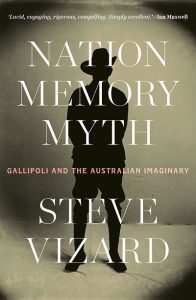
Reviewed by Richard Tutin
Nations use myths to shape their origin stories and guide the kind of society they seek to become.
For some their guiding myths are ones of courage and the ability to overcome adversity as they move forward towards their vision and destiny. For others the myths help tie the people to the land and their ancestors who lived in a far distant past and are now part of the geographical landscape of the country.
Associate Professor Steve Vizard’s detailed examination of myth and memory focuses on Gallipoli as a way of exploring its use as a national myth for Australia. There are dangers in using a battle of the First World War that was more defeat than any form of victory. Vizard’s choice hinges on its place in Australian history. Federation had been proclaimed only fifteen years before the battle began. Its rawness was very evident when Australia went into the war as part of the British Empire. It needed to join with neighbouring New Zealand to form the Australian and New Zealand Army Corp (ANZAC). Both ANZAC and Gallipoli have become legendary in Australia, with the battle’s myth now overshadowing its real and tragic origins.
It still begs the question about Gallipoli being a good choice for a national myth that can describe the aspirations of a young nation and a willingness to play its part as a member of the British Empire. As the book progresses Vizard seems to be heading in the direction of Gallipoli being the chosen myth. His argument is backed up by theories on myth and legend by a variety of academics and writers who veer between a romantic view and a more robust and practical concept of myth that can hold its own in any situation.
When we reach the final chapters Vizard begins to turn everything on its head to demonstrate that perhaps Gallipoli is not the best vehicle for an Australian national myth that is fit for purpose in the twentieth-first century. In doing so he highlights the great need that a national myth needs to be able to adapt and change as the nature of society changes. Gallipoli is bound in its place as part of a male dominated imperial world where not all members of society are included and some, such as non-white residents, are specifically excluded.
What is needed is a story that gathers the various cultures that are part of the Australian landscape such as First Nations people, women and those who have migrated to Australia looking for a better life. This is a far better outcome because it includes that ability to adapt and change as necessary to fit when the nation is at rather than just where it was.
It’s a challenging book designed to make the reader to stop and think. Although Gallipoli remains an influential element, a stronger national myth provides the nation with a more compelling rationale to communicate its narrative with vigour and conviction.
Steve Vizard is a prizewinning writer, broadcaster, lawyer and research professor at Monash University and the JM Coetzee Centre for Creative Practice, University of Adelaide. He has written books on topics ranging from Australia’s Constitutional Convention to Australia’s population challenge. He hosted his own Gold Logie-awarded TV Shows Tonight Live and Fast Forward.
Nation, Memory, Myth – Gallipoli and the Australian Imaginary
by Steve Vizard
(2025)
MUP
ISBN 9780522881271
$39.99; 324pp