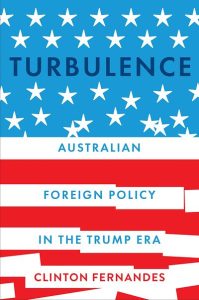
Reviewed by Ian Lipke
Clinton Fernandes was once an intelligence officer in the Australian Army. More recently he co-founded the Indo-Pacific Studies program at the UNSW where he assessed the threats, risks and opportunities that military forces will face in the future. There is little doubt of his qualifications to comment on the subject matter covered in Turbulence, the little book that grapples with significant issues.
We are used to considering AUKUS as an investment in nation-building. Not so, argues Fernandes. Rather it is our contribution to the USA’s war-fighting capabilities that is assessed. Since the Australian public have never been asked about this reinterpretation, the time to ask may be now. The author describes the President’s vision as escapism of the backward-looking kind. His views appear to be influenced by a time when the USA was rightly regarded as the dominant nation of the world. The slogan Make America Great Again is a fearful response to the problems of the present. Fernandes calls it a fundamentally negative geopolitical vision.
Fernandes shines his light on several political areas. Having considered various revolutions in Europe, together with the stated policies of such figures as Metternich and Robert Lansing, he concludes that the threat of a good example explains modern day Trump’s hostility to the BRIC association, and other attempts by developing countries to pursue independent economic integration. What Fernandes means by ‘the threat of a good example’ is never explained. The remainder of the segment Fernandes devotes to a catalogue of strengths and weaknesses vis-a-vis the United States and an explanation why the USA has removed its focus on Europe and placed it squarely on a new consideration of China.
Amusing (were it not so sad) is a comment comparing the Australian Government’s statements on Gaza as sounding “like they were assembled by throwing…a handful of word magnets at a fridge”. Fernandes identifies the real goals of US strategy as military dominance in the Middle East. Fernandes makes the claim that whoever controls oil can exercise global influence. Controlling oil in the Middle East means controlling the overseas sources of supply as well.
Fernandes tackles the issue of Trump’s motives for the many and varied choices he makes. The question of China seems to show that Trump wants global primacy over China. An alternative explanation is that he wants to see China separated from its major contemporaries.
The USA Defence Secretary once called Frontline China his ‘sole pacing threat’. The USA will defend their homeland but the ‘denial of a Chinese fait accompli seizure of Taiwan’ is now the Pentagon’s ‘sole pacing scenario’. Australia will be required to demonstrate its relevance against US objectives.
Turbulence contains a host of other material, every bit as relevant and important as the items mentioned in this review. It is a very important source of government policy.
Turbulence: Australian Foreign Policy in the Trump Era
(2025)
by Clinton Fernandes
MUP
ISBN: 978-0-522-88132-5
$29.99; 208pp