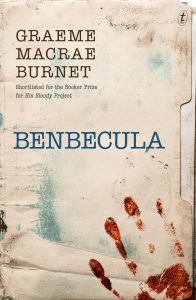
Reviewed by Rod McLary
Michael Dean – in an article published in the Historical Novels Review [Issue 88, May 2019] – drew a distinction between ‘historical fiction’ and ‘fictionalised history’ by saying the former is an ‘historical novel with predominantly fictional characters describing mainly fictional events’ and the latter ‘feature[s] real historical characters only and dramatis[es] real events.’ A very good working definition and one which satisfactorily places this novel in its correct genre which is fictionalised history.
The author Graeme Macrae Burnet writes exclusively in this genre – think His Bloody Project [2015] and A Case of Matricide [2024] to name just two of his novels. And Benbecula is no different. Its starting point is a triple murder which occurred on 9 July 1857 when twenty-five-year-old Angus MacPhee bludgeoned to death his aunt, his mother and his father in their home on the Isle of Benbecula – a small island off the north-western coast of Scotland. In due course, Angus was incarcerated in the Criminal Lunatic Department of the General Prison in Perth where he remained for forty-two years until his death in 1899.
The MacPhees were a poor family in a poor community but their dire situation seemed to be exacerbated by the nature of the family members. Angus’ mother and aunt are described as ‘ill-natured women’ and it is said that their conversation ‘consisted mainly of plaints about their circumstances and denigration of their neighbours’; and Angus’ father as ‘feeble as he was in body he was likewise in character’ [5]. One is tempted to conclude that the family and community circumstances were such that a violent outburst was always a possibility.
In this fictionalised history, Angus’ older brother Malcom sets down his story of the murders in 1862 and, in so doing, he tells his own story: of a man shunned by his community and deteriorating physically and mentally – and gradually losing his sense of self and his grip on his sanity. In a very moving and rather chilling section of his narrative, Malcolm speaks of the phantoms of his father, mother and aunt who come to him – not in the dark but in the light – and his being ‘gripped by a kind of paralysis’ [87] in which he believes he lives within ‘a prison cell of bone’ [his head] [87]. R D Laing the Scottish psychiatrist believed that psychopathology [or mental illness] had its origins in the ‘urban home’ where the ‘self’ is created. And Malcolm’s narrative goes some considerable way to support that belief.
In the penultimate section, Malcolm tells of the villagers coming to the house and ‘throw[ing] me to the floor and set[ting] about me’ and says ‘I do not feel any pain from their blows and do not wish for them to end’ [139].
While the brutal death of three family members is a tragedy, as the author states – there is tragedy too in the forty-two years of incarceration [Angus] endured in the Criminal Lunatic Department of the Perth Prison [168].
In an extensive Afterword, the author sets out the historical record of the murders by Angus MacPhee and his incarceration in the Criminal Lunatic Department. Indicating considerable depth of research, he provides annotations of the limitations of the written record and the processes of the Scottish criminal law at the time. The Afterword offers a further depth to the fictionalised history in the first part.
Graeme Macrae Burnet has crafted a fictionalised history of a brutal triple murder in the nineteenth century and has, through Malcolm’s narrative, forensically examined the family dynamics which led to the murders – and the slow unravelling of the narrator’s sense of self and his grip on his sanity. It is without doubt a fine achievement and one which will remain with the reader well after finishing the novel.
Benbecula
[2025]
by Graeme Macrae Burnet
Text Publishing
ISBN: 978 192305 861 3
$32.99; 176pp