Reviewed by Wendy Lipke
Award winning journalist Grantlee Kieza OAM is well known as the author of many books which foreground notable Australians who are never found in the history books yet their impact on our history has been of great worth. Among this esteemed group are people like Mrs Kelly, Annette Kellerman, Sister Viv and Mr and Mrs Gould.
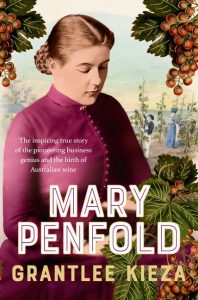
Mary Penfold was a new mum when she packed her bags to travel with her husband to Australia in 1844. While her husband, Dr Christopher Rawson Penfold, went about looking after his patients in South Australia, his wife Mary grew a cottage vineyard into a world-renowned wine empire, at a time when women were often excluded from commerce.
Of the thirty-two chapters in this book the first ten are devoted to Mary’s early life and the two men in her family from whom she developed a cool head for business and a powerful ambition. These chapters also document the importance of wine to society and medicine in England at the time. The reader is also told that grapes were one of the earliest recorded cultivated crops and that it was important to those who braved the seas like Captain Cook. Wine was also one of the important supplies on the First Fleet.
It is not until chapter thirteen that Mary Penfold and her doctor husband arrive in Adelaide which was, at the time, called ‘Port Misery’. The following chapters contain information about their life and that of relatives and friends as the colony grows.
The Prologue of this book describes Mary Penfold riding through her vineyard on her white horse, towards the end of her working life, surveying the fruits of her labour. The Epilogue tells of how she had given all she had achieved to family before she died but her example of tenacity and her pursuit of excellence comprised a legacy that offered so much more (305).
Mary’s family members ran Penfolds until the 1970s. In 1976 New South Wales brewer, Tooth and Co gained control of Penfolds after several changes in ownership. Penfolds is now part of Treasury Wines Estates yet the company’s traditions, begun by Mary and her husband, are said to still persist today.
In 2019 The Commander in Chief Shiraz Cabernet was released in tribute to its ‘original leading lady’, Mary Penfold (308), whose first experiments with fortified wines became the foundation for almost 180 years of Penfold wines.
The text is broken up by indented sections of primary source material as well as black and white photographs. Inserted into the text is also a sixteen-page block of coloured photographs, artwork, medals and portraits of important people who grace the pages of the story.
For me this book felt like a single grape. Mary Penfold’s life and contribution was imbedded in the centre of a broader history of the Australian wine industry and those, mainly men, who played an important role. This information is encased in eighty-four pages of endnotes, bibliography, appendix, acknowledgement and the index. In a book of four- hundred pages, Mary Penfold’s personal story, like all women at that time in history, takes up only a small space, yet her presence is there throughout. The majority of the text is centred around early Australian history in respect of the wine industry.
Even after her husband’s death Mary needed a male, her son-in-law and later her grandson, to do the marketing. But things were changing. By 1873 she was becoming known as a hard-driving businesswoman, a widow and a grandmother. Her reputation as the commander in chief of what was emerging as a major vineyard in South Australia, persuaded a newspaper reporter to take her story to the rest of the continent (262).
For someone who most of her life worked in the background, Mary Penfold will now be remembered for her own achievements within the Australian wine industry thanks to the time spent in research and writing. Grantlee Kieza’s story is well presented in a hard, dust jacketed book which deserves a place in any bookcase.
Mary Penfold
(2025)
by Grantlee Kieza
ABC Books
ISBN:978-0-7333-4327-8
$49.99; 400pp