Reviewed by Ian Lipke
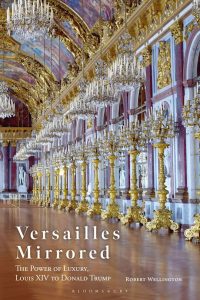
It would be a rare tourist who, on visiting France, chooses to decide not to include a visit to the Palace of Versailles, the construction that is ‘the defining symbol of hedonistic opulence in 17th century France.’ The palace is widely held as symbolic of the divine right of kings, that method of government, indeed that philosophical bent, under which the kings of the period justified their rule. During Louis XIV’s reign, France became the centre of luxury and fashion in Europe, and Versailles ‘the ultimate luxury showcase that has come to symbolise power through gilded magnificence’.
Versailles is the epitome of French taste, but it is not the only example that France gave to the world. The palace at Versailles did not come from nowhere. It belongs to a rich tradition of decorated villas and palaces, located for example in Italy, but established as chateaux and palaces throughout Europe, Asian countries and the rest of the developed world. Wellington makes the claim that Versailles is remarkable because the idea of Versailles is no longer attached to the palace itself. It is ‘a free, floating signifier for princely patronage’.
It is not to be thought that Versailles was to lie in splendour with no competition. Readers may think of Blenheim Palace, ‘a vast and ambitious palace that outshines any of the architectural commissions of the day. It has been called Britain’s answer to Versailles’. The land gifted to the Duke of Marlborough by Queen Anne, the palace exhibits the sensibility of a dramatist transformed into stone. it is a fitting symbol to Britain’s great general. Vastly different in conception of their models in that Louis XIV and his image-makers sought eternal fame for their monuments, Ludwig’s buildings were private follies and only incidentally, achieved lasting fame.
But there is much more to Robert Wellington’s study than Versailles. Through eight comprehensive case studies spanning the 17th to the 21st centuries the author provides anything but an inchoate look into how the extravagant palace style symbolised the state in the early centuries, was adopted by the nouveau riche to herald their wealth in the 19th century, and in our current century, was exploited by, and returned to a measure of state by, Donald Trump. The architectural traditions of Europe have been linked to the bumptiousness of a North American.
Beginning with Versailles we see an emerging picture of British wealth, German nobility, brash American barons, and twenty-first century property developers falling into line to worship. Some of the results were admirable, worthy of the great first model, without exception built with proper proportion in mind, and demonstrating an artisanship that matched the style and beauty of the concept it set out to portray.
Robert Wellington’s study identifies who was successful and who was not. The Sun King’s palace at Versailles became a symbol of wealth and power to measure the others against. To quote Wellington’s rather pithy comment, his book ‘is a tale of the beautiful and the tawdry, the glamorous and the gaudy.’ The story fittingly ends with Trump’s splurge with money to buy class, and ‘the world’s most expensive home’, that of the Crown Prince of Saudi Arabia.
The concept that trickles through Robert Wellington’s book is identified as ‘gilded ambition’. It brings together pockets full to bursting with gold, cash available when required. The gold is ready to feed the need. It’s a very good description of what drove the Sun King and what drove Wellington’s case study owners to build in subsequent years.
It is a fabulous idea.
Versailles Mirrored – The Power of Luxury
(2025)
by Robert Wellington
Bloomsbury
ISBN:978-1-350-45135-3
$34.99; 256pp