Reviewed by E B Heath
There is no time without the place, and no place without the time.
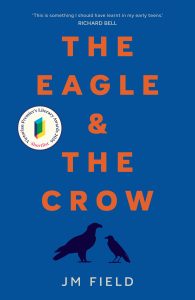
Dr. J. M. Field is a Gamilaraay man, his book The Eagle & The Crow is not an easy read, but it is beautiful. He explains the sophisticated kinship systems of the Gamilaraay, how they are anchored in time and place, how stories and songs acts as maps. He believes that in kinship there is enormous cultural and political potential for Gamilaraay and neighbouring mobs. They are his target audience but he also has in mind the western reader, whom he hopes will sense the richness of Gamilaraay culture. As a member of the latter, and without fully appreciating the depth of kinship, I am amazed at the intelligence of its architects.
Field studied maths and French literature at the University of Sydney followed by a doctorate at Oxford University, then returning to Australia he took up a McKenzie Fellowship at Melbourne. He is a research mathematician with a focus on the mathematics and genetics of traditional kinship systems.
To know the Gamilaraay it is necessary to locate them, to the Westerner this means to point at borders on a map. To Gamilaraay borders can only be understood through stories and songs, liminal spaces, where, say the Gamilaraay of the West might blend with Yuwaalaraay, but not so the Eastern Gamilaraay.
Place can only be understood through time, and time known only by place. The two concepts cannot be detached. To Gamilaraay, western maps are permanently frozen in the past.
Time past and time future for Gamilaraay is expressed via ‘yilaalu’ known as a distant time and place. Past and future – seem to be vertically stacked, it is worth noting that this ancient concept of time agrees with how modern physicists view time, where time forward and time past are treated as equal. Good to know we’re catching up!
There is then no future tense but expressed via the subjunctive mood ‘it might rain’. ‘Lateness’ is understood as one person who demands a present time but receives another time. To say, as Westerners might: ‘the wattle is late blooming this year’, makes no sense as the wattle is located in place and ‘place’ cannot logically be late.
Kinship provides formalised protocols and requirements of each individual as they relate to other people in their immediate kinship network, but is also scaled outwards ‘to family networks, to clans and to nation groups’. Language makes clear relationships, responsibilities and protocols. The project of language revival guided by settler linguists has failed to account for the intricate detail of kinship. Field gives the example: baawaa’ to simply mean ‘sister’, when strictly speaking it is ‘senior sister’. Whereas this would not be an important distinction to Westerners it is important as it indicates her relationship and responsibility towards other members.
Field explains Moiety as the highest level of division and goes on to explain, using diagrams, how individuals relate to one another in the kinship system, particularly in marriage. This of course keeps the blood lines fresh, avoiding incest among other things. It’s complicated. I wondered who were the architects. How could they possibly know, thousands of years ago, how important this would be for the continued health and vigour of small populations? To this reader it seems to be sophisticated scientific knowledge.
In the last chapter he remarks this small book is just a beginning, other topics such as how kinship maps to land, and how non-human relatives are included he leaves to others to discuss. I love the idea of non-human relatives. The concepts in this book, although alien to modern minds, resonate at an emotional level, and I am at a loss to explain why.
Field is also the author of Etta and the Shadow Taboo.
The Eagle and The Crow
by JM Field
(2025)
UQP
Paperback
ISBN: 978 0 7022 69127
$24.99; 144pp