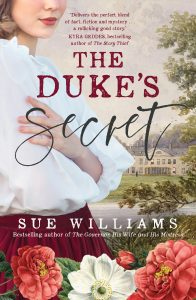
Reviewed by Wendy Lipke
In her latest historical fiction story, Sue Williams, author of Elizabeth & Elizabeth, That Bligh Girl and The Governor, His Wife, and his Mistress, has delved into a family legend, passed down through generations of William Williams from one who served as a footman to the Duke of Wellington at London’s Apsley House.
Like many of her historical fiction, the story is told of women associated with men of history. In chapter one, part one, the reader is introduced to Mary Ann Marshall, a thirteen-year-old house maid, who has an unfortunate incident in front of the mistress of the house and her daughter. The son, Arthur, coming on them defuses the situation allowing Mary Ann to scurry out of sight. The year is 1793 and the location, Kingston House, London.
In chapter two, readers meet Ava Washington, location Sydney in 2025. She is helping her mother downsize and comes across a box of letters all addressed to her. She then learns that they are from her birth father who she believed was no longer alive. On meeting him she hears of the belief of a connection to the duke’s footman. As a journalist Ava sets out to discover if there is any truth in this story and at the same time learn more about her birth father.
In this story of the two women closest to the Duke of Wellington throughout most of his life, the reader learns about a small part of the history of England and Europe, impacted by the Duke of Wellington. This is also his story.
Arthur Wesley is the fifth son of the Countess of Mornington, however two of them are now deceased. She refers to Arthur as her ‘awkward son’ (33) despairing that he was good for nothing (59). At this stage in his life, he is a man with no title, no inheritance and few prospects, spending too much time on his violin rather than in gainful pursuits (41). After being rejected twice in the marriage stakes for the same woman, a great transformation appears to take place in this young man. His name changes several times, he is given many honours as a soldier, especially after his defeat of Napoleon at the Battle of Waterloo, becomes an ambassador to France, and Prime Minister of Britain.
One of the main features of this story is the detail in which life at the time is revealed, the description of jobs done, the state of Europe and the various battles going on. Much is also said about the similarities and differences between the two great leaders – Wellington and Napoleon.
So great was The Duke of Wellington, revered at this time in history, that food was being named after him. With the restoration of King Louis to the French throne, we hear of the ‘Beef Wellington’ being added to French cuisine. The footwear ‘Wellington boot’ also becomes a fashion statement (292).
This story, told in the third person, adds little extras to interest the reader. As one of her characters is writing a book, the author takes the opportunity to explain how this should be done – ‘he should finish each chapter on an exciting moment, to make the readers eager to go on to the next one’ (277). This is exactly what she does herself in this book. As well as stating facts she also adds some of her own analysis of the situation she is describing.
Although it appears that the Duke of Wellington is the focus of this story, it is really the young maid, Mary Ann, and later the duke’s wife, Kitty, who play the main role. Through Mary Ann’s daughter with the duke, Elizabeth, there might be a link to the modern storyline. Mary Ann is probably the only one who has any influence over Wellington. Not in who he is but in some of the decisions he makes. They have had a connection from when she was thirteen and new to his mother’s house.
The story swings back and forth between London 1793 – 1800s and Sydney 2025. Each chapter has a title, and it is not until chapter 26 that the title ‘The Duke’s Secret’ appears.
Sue Williams is an award-winning journalist, travel writer and writer of non-fiction books. These skills have been used to good effect in her latest book. In the Acknowledgement section she says that her motivation for researching and writing this book was to try to prove the veracity of the legend passed through her own father’s ancestry from the footman, the first William Williams said to have served the Duke of Wellington in the 19th century.
This is an interesting book on many levels.
The Duke’s Secret
(2026)
by Sue Williams
Allen & Unwin
ISBN:978-1-76147-170-4
$34.99; 447pp