Reviewed by Norrie Sanders
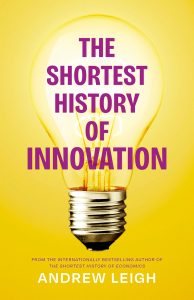
Innovation is the 21st title of the Shortest History series and must be one of the most challenging to write. The concept is abstract, the timeline is the whole of human history and the geography covers the world. Compressing all of that material into 220 pages means applying the most stringent of filters. The result is necessarily subjective – how to decide what is important and what is not?
The first chapter defines innovation and the ingredients that give rise to it. The final chapter is conclusory and deals with some of the modern challenges to innovation – information exchange and sharing the benefits. In between are nine chapters in loosely chronological order, grouped by “themes” that link diverse, and seemingly unrelated, subjects. For example, “Algebra, Gunpowder and the Plough” and “Steam, Vaccination and the Piano”. Fortunately, the links make more sense in the reading than in the chapter headings.
Every reader will have a different opinion about Leigh’s curation of the multitude of innovations over the last 3 million years, but suffice it to say that many of the usual suspects are there (such as electricity, evolution and computers), along with some novelties and curiosities that add to the entertainment value (such as Isaac Newtown poking needles into his own eyes; and the 1000-year gap between buttons and button holes). Innovations cover physical inventions and societal advancements, such as voting rights, currency, social media and music.
It is necessarily a rapid-fire journey and some topics might deserve a bit more. Plastics, for example, are both hero and scourge of the modern era, but only receive six lines of text. Perfume, in comparison, gets a whole page. But generally, the breadth of material covered is extensive and with sufficient detail to inspire more investigation.
A book full of facts, dates and figures could become as tedious as a high school history class, but this one is also replete with people. They make for entertaining diversions, but more importantly, they demonstrate the many ways that people innovate. The usual suspects are there, but some of the cameos belong to ordinary people who have been overlooked by history.
Quite a few myths are dispelled (the real inventor of the potato chip had nothing to do with the railway baron, Cornelius Vanderbilt; and the supposed inventor of the flush toilet – the famously named Thomas Crapper, was nothing of the sort). Thomas Edison’s “invention” of the light bulb is rightly questioned, but he does receive a higher accolade: Edison’s most important invention was to improve the process of invention [p111].
And innovation is context dependent. Cryptocurrency and blockchain advocates might be surprised to see that Leigh argues that a Kenyan mobile money scheme is more socially beneficial. [182]. He also questions the value of social media, citing an American survey that found that half of the Gen Z sample wished it did not exist.
It is self-evident that innovation is unceasing, but sometimes the benefits occur with astonishing speed. In 2003, two US based researchers published a paper on modifying messenger-RNA to produce proteins inside cells. Their work was under-appreciated until COVID arrived in 2019. Instead of taking 10-15 years to produce an effective vaccine, the m-RNA vaccines appeared within two years and effectively halted the world-wide pandemic.
This is an entertaining volume and its brevity makes for some easy reading. It reinforces the message that humans have become a dominant species on the planet by using their individual and collective brainpower. That innovation has led us to fundamentally change our world – for better and worse – and the challenge continues to be the sharing of the benefits and limiting the damage.
Andrew Leigh is a member of the Australian Parliament. He holds a PhD from Harvard University, and is a fellow of the Academy of Social Sciences in Australia. Before being elected in 2010, he was a professor of economics at the Australian National University. His books include The Shortest History of Economics, The Luck of Politics, and Battlers and Billionaires and Randomistas.
The Shortest History of Innovation
by Andrew Leigh
(February 2026)
Black Inc.
ISBN: 978 1 7606 4553 3
$27.99 (Paperback); 256pp