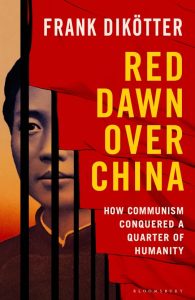
Reviewed by Wendy Lipke
This academic book, by well-known and respected (except by the Chinese government) Dutch historian Frank Dikötter, is the latest in his books on how China became the powerful country it is today. Dikötter is the author of The People’s Trilogy, which consists of Mao’s Great Famine, The Tragedy of Liberation, and The Cultural Revolution, which are highly critical of Communist-led China and now Red Dawn Over China.
Written on off-white coloured paper but including sixteen bright white pages on which can be found black and white photographs of key figures, the text contains tightly packed details. The book is divided into eight chapters which provide information covering from two to five years of history during the years 1921 to 1949. Following the historical text are ninety odd pages of notes and evidence of the author’s thorough research. One page, interestingly, provides information about the type of font used for this book, dating back to the 1500s.
The text is accompanied by several maps depicting China in the mid-1930s, The Northern Expedition 1926-28, the journey of The Long March 1934-35 and the location of The Civil War during 1947-48. These are on separate pages from the text.
It was interesting to read how the author came across some of the information from which this book evolved. Although China had closed itself off from the rest of the world and the Party controlled everything, copies of 300 volumes, containing Party documents from 1923 to 1949, found their way into Hong Kong and were available to those who knew about them.
Dikötter’s latest book, reveals how, with just a few members in 1929, the Communist Party was able to become the powerful entity it is today. What emerges from his evidence-based approach is that this was achieved through violence and a willingness to inflict it. But were they able to achieve this on their own?
The book reveals that there was financial and military support from the Soviet Union when needed. And that the rest of the world did not recognise any cause for concern from this new power base. By 1945 the Party began to grow rapidly. Mao had created a formidable propaganda machine, and the Party was tightly controlled. He also now had at his disposal a sizeable army which did not follow recognised rules of engagement.
When Civil War broke out and Chaing Kai-Shek fled to Taiwan, the Party referred to its conquest as a ‘liberation’, allowing a progressive vision more in line with the spirit of the modern age. Many other countries accepted this view at the time. Dikötter blames the US for not helping Chaing Kai-Shek at the time and so allowing Mao’s power to flourish.
Dikötter’s general argument is, that “Communism was never popular in China.” It was imposed on the Chinese through systemic, unrelenting violence.
This is a thoroughly researched piece of work and adds to the number of books Frank Dikötter has already produced on explaining how China’s regime came into power and cemented itself as such a huge player in the world today.
Red Dawn Over China
(2026)
by Frank Dikötter
Bloomsbury
ISBN:978-1-5266-7071-7
$34.99; 384pp