Reviewed by Jim Posner
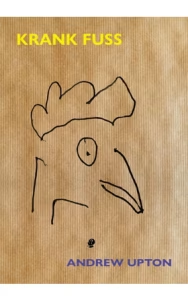
Krank Fuss is a novella by the Australian born playwright Andrew Upton. Now resident in the UK, Upton has crafted a thought-provoking allegory in the mode of George Orwell’s Animal Farm, where the story is told through the voices of animals living on a farm. This particular farm is situated in Germany in the period just prior to World War 2 and the Nazi administration does get a brief mention by one of the few humans who appear in the book.
The central character is a chicken called Krank Fuss. A rough translation in German would be sick foot, and Krank Fuss does have a misshapen claw, which we are told he has lived with since he emerged from an egg. This misshapen claw will play a crucial part in the story.
At the start of the book, Krank Fuss is purchased along with five other chickens, who are all given a personal name, by the owner of the farm. The farmer places them in a box to transport them to the chicken coop where they will live. The chickens believe the farmer is a fox, and the box is the fox’s stomach. They think they are therefore on the point of death, which is perhaps why all of them, other than Krank Fuss, take a safety-first view of their new environment. Especially as they craft a view of this home as being part of a giant spider’s web. Krank Fuss is the only one who wants to know more about their surroundings.
You will rouse the spider against us, one of the other chickens, Smart-Hen, tells Krank Fuss, with all your arrogant explorations.
Krank Fuss though, will have none of it and after meeting a seemingly omnipresent toad / frog, called Gibby, they proceed on a comprehensive tour of the farmyard. Krank Fuss, who represents an Everyman figure, with little initial knowledge of the world, is educated by Gibby as they meet, and converse with other animals including a calf, a horse, two dogs and a malevolent cat. The conversations and shared experiences during their wanderings lie at the heart of the book.
Without given too much of the story away, Upton cleverly hints at the Nazi atrocities of those dark years, through the futures, or lack of them, of the animals, and the world they inhabit. The second half of the book explores some barren themes and the impact which this has on the animals that live on and around the farm. Upton wants us to consider whether we can ever be certain about who to trust and what can be learnt through experience. There are no easy answers, but there is always light at the end of the tunnel. The narrative voice changes in the final section of the novella, which is confusing, but there is an underlying sense of hope for the future.
If I had a criticism, it is the simplicity of the language used by both the animals and the humans. Upton’s phrasing can be almost lyrical; the clouds snapped apart like cauliflower to reveal the rich, blue daylight that was always behind and around them, is an example. But the conversations between the animals and humans are more basic. No doubt this was deliberate, but greater depths in the conversations could have created a clearer idea of the characters of the main participants.
The story is additionally enhanced by a series of impressionistic line drawings of the animals we meet around the farmyard, as well as some of the incidents. These are dotted throughout the book, and as the name of the artist is not provided, I am guessing that they are also the work of Andrew Upton.
This fable deftly explores an ostensibly stable world which is tumbling into chaos and violence. Never has a chicken’s life been more complex.
Andrew Upton was born in Sydney in 1966, and is a writer whose career covers theatre, film and television. He has written the original plays Hanging Man and Riflemind, as well as a number of classic adaptations including Ibsen’s Hedda Gabler, Chekhov’s Cherry Orchard and Rostand’s Cyrano de Bergerac. As a writer and Director, he led the Sydney Theatre Company (STC) for eight years, first as co-Artistic Director alongside Cate Blanchett, then as sole Artistic Director. During this period Upton was also a writer at the heart of a significant dramatic project at the UK’s National Theatre, creating a series of dramatic adaptations with the Director Howard Davies.
Since leaving the STC Upton has returned to the Company as a freelance writer with adaptations of Chekhov’s Three Sisters and The Seagull. Most recently he has been a principal of the production company Dirty Films, with his credits as a producer including, The New Boy, Shada, Fingernails and Stateless. Additionally, he co-created and produced the Audible original podcast series Climate of Change, focussed on approaching climate change through solutions-based initiatives and conversations.
Andrew Upton currently lives in the UK with his family, three dogs, endless chickens and occasional pigs.
Krank Fuss
(2026)
by Andrew Upton
Puncher & Wattmann
ISBN 978-1-92309-981-4
$32.95 hardcover;148 pp
Andrew Upton will be touring Australia this August. For events and tickets: https://krankfuss.com/author-tour