Reviewed by Ian Lipke
Aficionados of mystery writing are used to greeting the latest Michael Connelly story with enthusiasm and pleasure. The American author has written many books, all mysteries, and most where a murderer is brought to justice or a spy comes undone. A simple outcome in each case but delivered to justice only after a tortuous description of fair comment or clever police work has entertained readers.
The usual pattern shows a dedicated team of lawyers who take on duties beyond the reasonable. They compile evidence for the sole purpose of rendering their leader triumphant before an inimical judge. The lawyer who presents the defence is often Mickey Haller. This lawyer builds his arguments until the climax spills into a release of tension and success for the Haller team.
That is often a fair description of what happens in Michael Connelly’s courts. Endless variations to this basic model exist. But The Proving Ground is different. First, the case treats a civil matter, one that carries a penalty of millions of dollars. It does not fall under the heading “Criminal matter”.
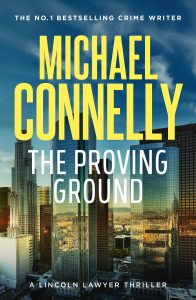
In essence, the story is as follows. When a teenage boy murders his ex-girlfriend after a chatbot tells him his actions are justified, defence attorney-turned-civil litigator Mickey Haller takes on the victim’s mother’s lawsuit against a powerful AI company. TidalwAIv, the tech company behind the chatbot, is courting billions in buyouts while skirting accountability. Attorneys for the tech company want to offer a substantial amount of money, in the hope that it will buy her silence and make everything go away. Brenda Randolph, however, wants them to apologize publicly, take responsibility, then safeguard their chatbot from ever encouraging another killing. From a public relations standpoint, though, those terms don’t really align with TidalwAIv’s agenda, and they go to court.
With the parties unable to reach a settlement, Haller readies his case for trial.
The defence team, aware of Haller’s reputation, presents a massive amount of discovery, too much they believe for their opposition to work through. However, Jack McEvoy, who is planning to write a book on the trial, joins Haller as a research assistant. Haller, realizing McEvoy could be a powerful asset, trades unprecedented access for the journalist’s keen eye for detail, and together, they delve into the discovery, uncovering something that Haller hopes might be the “smoking gun” they need. Proving it won’t be easy, though, and with time running out, Mikey’s only play is to take the biggest risk of his career.
Set against the backdrop of a Los Angeles that’s still ablaze following tragic wildfires, Mickey Haller enters the courtroom for what he knows is the most significant case of his career, and a fine piece of mystery writing results.
Connelly has, unfortunately, let his reputation as a fine writer carry this story forward. He has failed to consider the commonsense factor. The baiting of the defence team was not clever but tedious and not to be believed. The response of the defence was immature. Their continual outwitting by Haller grew boring; one was reminded of The Three Stooges of Hollywood fame. Knowing little of the behaviour of judges makes me hesitate to comment on the behaviour of Judge Ruhlin except to say I felt uncomfortable. Other officers of the court or constabulary were depicted as dumb, obtuse, or presenting arguments that seemed defeated from the outset.
Despite these shortcomings there appeared enough strength to allow me to judge this story positively.
The Proving Ground
(2025)
by Michael Connelly
Allen & Unwin
ISBN: 978-1-76147-340-1
$34.99; 400 pp