Reviewed by Ian Lipke
‘The Dingo’s Noctuary’ is an extended illustrated verse novel set in the remote Tanami Desert, addressing themes of cultural alienation, the post-colonial landscape, death and transcendence. While it is an account of personal relationships, its broader ontologies draw from a cultural horizon that predates her relationship with the aboriginal people. ‘The Dingo’s Noctuary’ is a story of finding belonging in non-belonging, and identity inside hybridity. This novel is written for those who fall into the cracks between cultures or identities, and who may never have certainty around their family history. (Abstract, Judith Crispin’s thesis, Professional Doctorate, University of Sydney).
At the heart of the tale is a soul’s dark night, the flight of a lady motorcyclist, in the prime of her invisibility, and her mongrel dingo Moon, into the Tanami desert. She is searching for a caravan of miraculous dog-headed beings, glimpsed in dreams and the dementia tales of an old desert lady.
The book was written over thirty-seven desert crossings, sometimes on the motorcycle with the dog on the back. The entire second half of the book was written on a typewriter after a motorcycle crash (the unsuccessful 37th crossing) left the author unable to use a computer. This is a very personal novel. It is an answer to the author’s need to reconcile her own lost aboriginal heritage (she is of the Bpangerang people) with her white upbringing. She incorporates a unique visual art method to honour the dead. Using the remains of animals and birds killed on roads, she highlights the impact of human technology on the natural world.
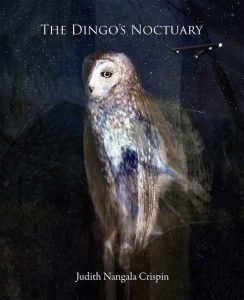
One of the outstanding aspects of the story is its innovative form. It is highly successful in blending poetry, prose, hand-drawn maps, plant pressings, star charts, and unique “lumachrome glass prints. The text and images are equally weighted, creating a rich multi-layered narrative. Even the title of the work implies a night-time tale with its exploration of dark, complex themes.
It is insufficient to pass by with a bland reference to a ‘verse novel’. That fails to mention not only the thesis requirements made mandatory by the university, each of which is stamped with individuality, but also the Author’s Note. This carries the originality of the writer e.g. dingoes are nowhere people, her own thinking, own seeing, own experiences together giving her own connection to country. The Note is supported by a Preface. Its focus is on animals, dusk and dawn (the hour of the wolf) when the risk of collision is most likely to mean physical risk and transition of souls from one locality to another.
The Contents, the most developed section, is magnificent. It is as though the author turned on the creative tap and forbore to switch off the flood that followed. Wormwood (part 1) describes Fitzroy Crossing and introduces the mystery of the Crossing in imaginative verse.
The saga begins:
Listen – this is no fairy story.
A star is always coming down over the Tanami, before and now, always falling, always
shattering itself against the atmosphere, casting its body down in fragments, carving
craters in the desert floor like gates…
The rhythm of the language is distinctive, haunting and musical, totally fitting to the tone of the whole piece. It then steps to an introduction of Space Emu. We’re told that:
Space Emu is dying, plunging back into the unlit waters below the world.
Then comes the First Vision, a passage one-and-a-half pages in length. This is the introduction to many further passages of vast beauty, clearly written with a masterly skill.
This book is not easy to comprehend. Only if the reader is prepared to step up to its challenge will the rewards be won, but those rewards will be stupendous.
The Dingo’s Noctuary
(2025)
by Judith Nangala Crispin
Puncher & Wattmann
ISBN:978-1-92309-971-5
$85.00; 324pp