Reviewed by Rod McLary
How do you effectively write a history of your family when the written records of the time in which they lived [the nineteenth century] are so limited? The answer is a simple one – you take the official records [births, deaths and marriages and so on] and construct a narrative around them drawing on your knowledge of the historical events and societal norms of the times. And this is what Don Alcock has done in the fictionalised history of his great-great-grandfather Richard Belsar. What cannot be reconstructed are the subtle nuances of relationships, inner thoughts or those more intimate moments of our lives and there the author can only guess what they may be. As Margaret Atwood said [quoted in the novel’s epigraph] the past is a great darkness, and filled with echoes … we cannot always decipher them precisely in the clearer light of our day.
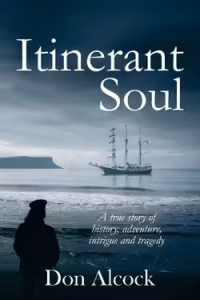
In Itinerant Soul, Don Alcock has brought the history of Richard Belsar to life. We gain some knowledge of how he and his family eked out their lives in hardship and poverty; a life where the dreams of finding a fortune on the goldfields of Victoria or owning a small land holding provided some respite from the day’s struggles but sadly were never realised. Richard’s story – and that of his family’s – is told within the context of the historical events taking place in Australia.
His beginnings were humble as he was born in 1815 in Liverpool, son of John and Ann. After a rudimentary education at the local catholic school, Richard at age 16 started work on the docks. In December 1835 though, he was charged with larceny after stealing some razors and a watch guard and subsequently spent one month in the Liverpool Borough Gaol.
In July 1836, keen to leave behind the memory of his time in gaol, the judgement of his fellow dock workers, and the gloom of his home after the recent death of his sisters, Richard joined the crew of the brig Charles bound for Newfoundland. And from this beginning, Richard began his eventual journey to Australia via San Francisco on the Rory O’More. Its arrival in Launceston was announced simply in The Launceston Examiner – ‘Arrived 17 August 1850, Launceston. Rory O’More from San Francisco’ [115].
After eight months, Richard was out of money so joined the crew of a whaler – ‘three months of stench, black smoke and oil’ [122]. And when he collected his bonus wage at the end of the time, he decided to travel to Melbourne and there in 1852 ‘the trail goes cold’ – there were few records kept in the new colony of Victoria. But in 1856, his life intersects with that of Elizabeth Carter who is travelling to Sandhurst – a small locality now part of Melbourne – where she is to take up a position as a domestic at Tyler’s Halfway House. Richard also takes up a position there as a labourer. It seems inevitable that Richard and Elizabeth would make a life together and they did. On 4 August 1857, they had their first child Ellen Jane Belsar.
The author has not shied away from difficult events in Richard’s and Elizabeth’s lives. After an insult by a storekeeper alluding to time in a Liverpool gaol, Richard thought of ‘the back-breaking work ahead, the low wages and the burden of responsibility’ and returned to the store late that night, broke in and stole provisions. After drinking rum, he fell asleep and woke up and was arrested. On 10 February 1863, he was sentenced to two years hard labour – leaving Elizabeth and the children destitute and reliant on charity for sustenance. There were other tragedies as well – the death of a child lost in the bush, another child lost to illness – but together Richard and Elizabeth forged on. While their dreams of a strike on the gold fields or owning their own property did not come to fruition, they stayed together and made a reasonable life for themselves and their children.
Don Alcock in writing about his great-great-grandfather has captured a snapshot of colonial Australia as seen through the eyes of men and women who are struggling to survive in a sometimes-unforgiving country. It is a piece of social history recording ‘the lived experiences of ordinary people’ as they make their way in the world. Itinerant Soul is well worth reading for its representation of nineteenth century Victoria and the engrossing story of Richard Belsar.
Itinerant Soul
[2025]
by Don Alcock
Turtle Publishing
ISBN: 978 176424 410 7
$32.99; 346pp