Reviewed by Norrie Sanders
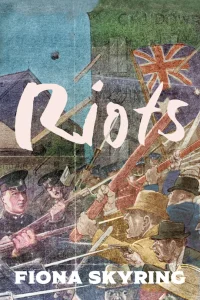
The cover and title give little away – police armed with bayonets facing men in civilian clothes with sticks and swords, all under an Australian Flag. But Riots is a very specific story about civil unrest that centred on soldiers freshly returned from supporting the British empire in World War 1.
The ANZAC legend is an important story in Australia’s modern history that helped to frame a national identity steeped in mateship, endurance, courage and ingenuity. Riots doesn’t attempt to topple this edifice, but it does show that in the immediate aftermath of a world war, not everyone bought the legend and the returning soldiers soon became part of a fractured society, struggling to come to terms with a broken post-war economy.
The profound impacts of a brutal war on many of the soldiers – shell shock/mental health, desertion and lack of bravery – were brushed aside. Soldiers who had endured this hell were angry with their treatment – a country that could not understand their experiences and seemed to be doing little to compensate those who fought.
In common with other nations in the war, there was an enduring resentment by soldiers of the civilian society for whom they had gone to war [p72]. Violence often resulted and, for example, riots and mutinies occurred across the United Kingdom in 1919 [p72]. Recognising the wartime experiences, Australian police, the judiciary and the media were lenient towards offending soldiers and the media frequently denied clear evidence of soldier-initiated violence. In doing so, they, and much of the broader society, were unwilling to taint the newly minted ANZAC legend.
Australia at the end of the wars and in the years after remained a deeply divided society. Bereavement and grief had touched many families, people surrounded by the devastating impacts of war, and damaged and broken men were visible everywhere. Yet these shared experiences seemed to be not enough to heal the rifts. The fissures were along familiar lines – class, religion, ethnicity and ideology………Disagreement became insult, specifically an insult to soldiers’ sacrifice but also more widely an insult to the collective sacrifice of the nation. In this emotionally charged landscape, debate and diversity of opinion were considered an affront [p186].
The riots occurred across Australia from the major cities to the mining towns. They were often fuelled by alcohol and often happened at public forums – speeches in the open-air domains, strikes and even commemorative parades. Commonly, unionists (a.k.a. reds or communists), anti-war and free speech advocates were pitted against “loyalist” soldiers, who had backing from police and conservative politicians.
But there were exceptions and nuances. In Adelaide, the soldiers supported unionists against strike breakers. And not all soldiers were pro-war – many were strong advocates against war. And even the various returned soldier’s organisations had differences that found their way into the unrest.
The scale of many riots are included in the book, but it is not easy to gauge what proportion of the returned soldiers supported the riots, or the long-term legacy. The descriptions of the genesis of each riot suggest more about opportunity than a systematic campaign of civil disruption. Either way, Fiona Skyring argues their significance: The Melbourne returned soldier riots were among the most serious riots in Australia’s twentieth century history [p128]. Riots is a valuable documentation of an unusual set of events that sheds light on aspects of Australian society that are still echoed today.
Fiona Skyring is an Australian historian and award-winning writer. Her book Justice: A history of the Aboriginal Legal Service of Western Australia won the WA Premier’s Prize, the WA History Prize and the Margaret Medcalf Award and was a finalist for the Human Rights Awards.
by Fiona Skyring
(November 2025)
UWA Publishing
ISBN: 978-1-76080-309-4
$39.99 (Paperback); 280pp