Reviewed by Wendy Lipke
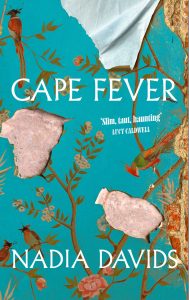
Cape Fever is the Australian debut novel for internationally celebrated playwright and novelist, Nadia Davids. Born in South Africa she now lives in California. The story is set in the 1920s. One assumes the location is South Africa as information throughout the book about specific districts fits the makeup of this part of the world.
Soraya Matas, lives with her parents in the Quarter, a district bound together by faith and family. But these families are poor. Many before them were bought to this land as slaves. Children are sent out to work early to help support their families. Soraya has found a job as personal maid to English born Mrs Hattingh in her beautiful decaying home, Heron Place. For Soraya this is not her first job, as she is now nineteen and engaged to Nour who was the brightest boy in her class. He is striving to better himself and become a teacher after he has accumulated some money.
Soraya, who is the narrator of this tale, sees what others do not, especially Gray Women, who are not quite ghosts. When she was younger, she blamed these for any of her bad behaviour. Growing up she was a storyteller for the younger children but as she grew older, she was charged with putting aside the storytelling as it was now the time for work. When her stories frightened the younger children, people in the Quarter began to blame her for anything that went wrong in the district.
Mrs Hattingh, Soraya’s employer, receives mail from her son in England who she tells the maid is coming to visit, so his room must always be in readiness. But these visits do not eventuate.
There is a strong emphasis in this book on class and race, and a few words used may be unfamiliar to some readers e.g. abdas, rakam, jinn, buchu. The main characters know their expected roles in a colonial empire. Mrs Hattingh is quite convinced that she knows best and has the right to interfere in her maid’s life. Soraya believes that her employer is among the people who are perfectly at ease with doing the wrong thing for centuries and then expecting gratitude for doing the right thing for a moment (51).
Soraya has been taught well by her mother how to hide her feelings from her employer. Yet that is not all that she hides. Mrs Hattingh assumes that her maid cannot read or write and so suggests writing to her fiancé for her. This becomes a weekly ritual, yet Soraya is never allowed to keep any of the correspondence. Gradually the contact with family is restricted and letters from Nour diminish. Mrs Hattingh assures Soraya that she is better without him, but the maid becomes suspicious. Soraya finds the sameness of Heron Place suffocating. She is lonely with only the old woman and the house spirits for company (102).
Things come to a head after Soraya is not allowed to go home until she hears of her father’s death. On her return to work she can no longer hide her anger and frustration.
I am sure readers will be happy with the outcome of this story. This is an unusual tale about a particular place at a set time in history. It is also the story of two people, growing up in different circumstances who find themselves living in the same house. The story shows that regardless of class, individual people have the same needs, sorrows and frustrations and often the tables can be turned.
Cape Fever
(2026)
by Nadia Davids
Scribner
ISBN:978 1 3985 5423 8
$29.99; 240pp