Reviewed by Ian Lipke
Few readers would turn away from a gripping murder and the mystery that accompanies it. Imagine a yarn, fiercely told of a murderer in your community and the excited buzz of police carrying out their investigations. The belief that this is what I could expect is sold clearly to new readers of Murder at Thornwood Park. It is not what the printed book delivered.
As I read my way through the first hundred pages, I found that, each one-and-a-half pages I was refusing to carry on because I was bored. Next to nothing was happening to advance the plot, the writing was pedestrian, and I felt I was in a make-believe world that was inhabited by cooing females. Female to female interactions are explored almost exclusively in the first one hundred pages, while male to female conversations appear to be Ken Aberdein to Rose on two occasions only.
Even though this story was written exclusively to interest females – although I suspect the author would deny this claim – the unearthing of positives is possible. One could make the claim that the writer is a master at intertwining romance with the Australian bush. Her storytelling is compelling and draws the readers into an unconscious identification with the major characters (despite our regarding her actions oftentimes as silly).
Several critics have described Joan Sauers’ writing as cosy and compulsive. One regarded her prose as “a must-read for fans of cosy crime with a touch of mystery and a load of charm”. A second critic has diverted a little from the truth when she writes, “Atmospheric and intriguing, this cosy murder mystery sees Rose McHugh uncovering a little-known part of Australia’s history inside the ghastly mansion at Thornwood Park.” To see Rose McHugh as a feminist Miss Marple who won’t stop denigrates the place in literature that Christie’s heroine holds. However, scenes which contain the mysterious hall in the Park are well described as ‘atmospheric’.
To speak of Marple and McHugh is an interesting comparison to make. Marple is a retiring, elderly lady well brought up in the spirit of the day, subservient to the place of men. Yet she has an iron will that directs police attention to what she considers important. Rose McHugh is much more at ease in her society. She is comfortable with minor characters like Ken Aberdein or George or Eric. It is presumed she might hold her own with police officers should she ever meet any. In fact, she does, but not until one-hundred-and thirty-seven pages have passed.
An easing in the tension of the dialogue is noticeable when the lower ranks in the police force combine informally against their senior officer. While DCI Al Addison is entirely to blame, some excuse can be found in the times beyond which the crimes supposedly occurred. Examples of dialogue racing unrestrained appear on pages 166-67.
This story, despite its weaknesses in the early pages is an honest attempt to produce a haunting mystery, lush with landscape, with history and a decaying Hall that could well be haunted. Its conclusion is of a standard to be admired.
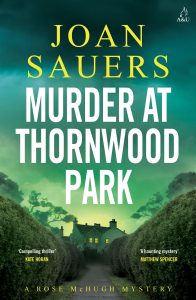
Murder at Thornwood Park
(2026)
by Joan Sauers
Allen & Unwin
ISBN 978-1-76147-250-3
$34.99; 384 pp