Reviewed by Ian Lipke
Readers with more than the slightest interest in Nature will love this book. On one level it is an excerpt from the life of Min Drysdale who lives a solitary life on an island with her father and deputy ranger Werner. Because of her largely separate existence, Min has become an expert on Tasmania’s wildlife but is sadly lacking in knowledge of the social awareness that is the way of life of her contemporaries.
Min’s life is anything but normal. Without a mother she relies on Piers, her father. Unfortunately, his belief in what a growing into adult young girl needs to reach maturity is nowhere like realistic. She rebels by taking up with a young man, who has his own interests to consider. Min’s romantic attachment to Fergus, the young man she has helped to rescue, is based on not much more than her reading of her mother’s copy of The Tempest. Life under her overprotective father’s rule fails to protect Min’s virtue.
Another major character, Lucie, whose early interest is in seabirds, is faced with an ethical dilemma when she discovers that her husband, Ian, has been re-winding kelp in barren areas of the ocean floor. Reseeding spores directly to the ocean floor was never regarded as an ethical, or indeed legal, method.
Lucie solves her issues with her husband by gaining a reputation in the publishing community for scholarly writing. She publishes a broadsheet on storks in England and migrating elephants in China. She moves to France on her own where she is introduced to the mating calls of a pair of wolves, and eventually to Tasmania to study Tasmanian Devils. This is where she meets Min.
However, the story under review is not about the fortunes or otherwise of two girls. They are the glue that holds the important ‘stuff’ together. We can sympathise with the girls’ living as they do in unfortunate circumstances. Our hearts go out to Min who gets about in clothing her mother left behind. She has one bra, scored when the tourist who owned it left it behind, and a jumper gifted to her by a senior scientist. She is ignorant of contemporary life, best illustrated with her lack of knowledge of pop princess, Taylor Swift. Yet we realise there is hope for her. She is highly intelligent and capable in her broad and detailed knowledge of the kingdom of nature.
In casual conversation, Lucie expresses guilt about the misdeeds of the past years. “My great-grandfather was a possum trapper”- she cleared her throat – “but I think that, back when he was young, he trapped thylacines”. This leads to Werner counselling Lucie about feeling guilt about misdeeds of the past.
But Every Wild Soul is much more than a discussion of individual human issues. The story, in its own subtle way, raises important issues about development and conservation together with unintended consequences that can occur. Min is one carrier of the light, (as is Lucie through her magazine writing) but minor characters contribute. Werner recognises the urgent need for climate action with renewables. Ian is devastated by this country’s record of extinctions but recognizes no action to take.
An overlooked character, who is much more influential than he believes, is Werner. He makes a valid point about employment in the conservation industry. He claims that his job was to identify species that were at risk of becoming endangered. He saw that as his job and asks the question how he was supposed to get work elsewhere. (Min’s father, Piers, had sacked him).
This is an interesting story that examines the lives of two interesting characters on their way to enlighten readers about conservation, development and consequences.
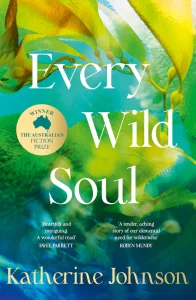
Every Wild Soul
(2026)
by Katherine Johnson
Harper Collins
ISBN: 978-1-4607-6830-3
$34.99; 336 pp