Reviewed by Ian Lipke
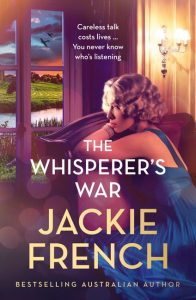
In 2013 Jackie French created a history of Australia called Let the Land Speak. I read this book with a great deal of attention combined with a great deal of pleasure, as this particular writer was new to me at the time and kept my attention. For some years I have been looking for all publications by Jackie French but for one reason or another was able to find only one, the Miss Lily series. Then, just last month, my searching was over. To my delight, I discovered a novel by Jackie French called The Whisperer’s War. With great anticipation I set out for what I anticipated would be the highlight of my reading career. Published by Harper Collins the book’s presentation is all that one might expect. The cover is in rich colours, obviously prepared by a professional artist, while the print throughout the book is sharp and easy to read.
The story tells the tale of a young woman who is wealthy, part of the upper class in the United Kingdom, socially aware but prepared to assist fellow workers in such mundane activities as collecting animal manure and spreading it across the land. A second part of her life revolves around her position in society which she uses to gain information that she then passes on to the authorities in London who are pursuing the Second World War.
The reader may be sceptical about the extent to which she could possibly affect the direction of the war. However, s/he is forever aware that this is a piece of fiction; it is in fact a very well told piece of fiction.
The novel retains interest from page 1 until perhaps page 300, then the story needs to be traced from the standpoint of two different characters. From the very beginning it has become clear that this is a book for women. Each chapter begins with a recipe, yes a recipe, or alternatively a quote from someone like Sir Winston Churchill (for example, Chapter 2 begins with the recipe for Woolton Pie.) The author tells us the ingredients in both the filling and the pastry and then explains the method by which the pie might be cooked. She then provides the information that the recipe is supplied from the Ministry of Food. Immediately after this the story resumes. The chapters, by and large, are reasonably short, around 8 to 10 pages. Chapter 3 begins with a witticism: better potluck with Churchill today than Humble Pie under Hitler tomorrow. The story then resumes.
The characters in the story are reasonably well drawn. It becomes important to realise that although they appear to be heroes following the British lion it’s not always so. One appears as a hero, plays a reasonably large part but then disappears; we learn he had been shot by firing squad. Another character, who appears to be the brother of Lady Deeana, is unmasked and hanged.
Even so, the focus relies strongly on the female character Lady Deeana. She is well painted and is a person that we can identify with that readers can come to enjoy.
While the story is clearly geared towards the female reader, there is nothing to stop males reading the story and enjoying it. However, by the time we’ve read to perhaps page 300, Deeanna has been removed from the action scene, becomes more involved looking after three children whom she strangely adopted without any fuss from officialdom, and her part in the book becomes more and more involved with the lives of the children. From approximately page 300 on, I was waiting desperately for the book to finish.
In short, so much time was devoted to family affairs that I was bored.
It had never occurred to me that, in reading Jackie French, I would charge her with writing a boring book. Her history book, Let the Land Speak, foreshadowed excellent writing to come. I understand she has already enjoyed that career and I would love to see another serious nonfiction book from this order.
The Whisperer’s War
(2025)
by Jackie French
Harper Collins
ISBN:978-1-0389-0389-1
$34.99; 464pp