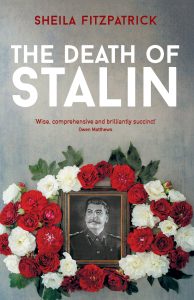
Reviewed by Ian Hamilton
One imagines that the work of historians has at least two dimensions: the first dimension being to understand past events, including their causality (if that can be determined or surmised) and significance. The second dimension is to examine how that past has influenced – even shaped – our present world and how historical investigation enhances our insight into current prominent people, societies, politics, culture and events.
With this in mind, the reader of Shelia Fitzpatrick’s concise book about Stalin might expect to grow in knowledge about the Russian people – or at least their political elite – and the present Presidency of Vladimir Putin. To some extent, the book does take its reader there but more by inference than explicit analysis and interpretation. Perhaps that is simply the expression of the self-restraint and scholarly discipline which people like Fitzpatrick evidently value. Perhaps her purpose does not extend to linking Stalin’s values and behaviours to the values and behaviours of Putin.
The straightforward chronology of this text means that the reader has every chance of understanding who did what when. We might also have a chance to understand Fitzpatrick’s views of why they did what they did.
So, Chapter One starts at the beginning, tracing his early life in Georgia. He was born in 1879 as Joseph Vissarionvich Dzhugashvili. Fortunately for us his nickname is easier to conquer. Apparently, Stalin means “man of steel” and it obviously promises certain character traits and moral norms. The book takes us into those. His mother had ambition for her son beyond his lowly start in life and she tried to ensure that by placing him in the Orthodox seminary in the capital. Fitzgerald wryly notes: “What was unusual about Dzhugashvili was not only that he transcended his lowly origins to rise to greatness but that he achieved this via the usually dead-end route of being a revolutionary.” (p3)
Indeed, the author notes that he abandoned any belief in Orthodox Christianity and replaced it with the Marxist world view (as the basis for communism). By 1917 he was a member of the Politburo, although as a back-room operative. The early revolutionary years, leading up to Lenin’s death in 1924 are helpfully explained. The factional rivalry, the role of Trotsky, and the policies of “collectivism” round out Chapter 1. The failures of collectivism were “glossed” over at the time and critics effectively silenced.
Fitzpatrick stresses that Stalin was more than a one-dimensional man. He was well-read and open to the artistic values of much of the Western canon. In other words, his thinking was not totally antithetical to European culture. He established surprisingly cordial relations with Roosevelt and Churchill in the “strange bedfellows” anti-Fascist alliances of World War Two.
The author moves swiftly to 1953 and Stalin’s death, which is, after all, the promised focus of the book. He died on March 1st, as a result of multiple strokes. While there have been theories about his being assassinated (Beria? Khrushchev?), Fitzpatrick sides with the majority scholarly view that he died of natural causes. Several times in the book she refers to the death-bed behaviour of the remaining leaders as farcical and she takes some delight in Iannucci’s satirical film The Death of Stalin. Despite these portrayals of the remaining leaders, they ensured stable government and began a series of reforms.
One of the things stressed in the book is that powerful men, such as Trotsky and Beria, were still vulnerable to suspicion and accusation. Stalinist USSR will be long remembered as a dangerous place, especially in seasons of purging. Perhaps because of his brutality, his reputation post mortem was denigrated (by some, not all) and emblematic acts, such as renaming Stalingrad and the destruction of statues typified the post Stalin era.
Readers wishing to link Stalin’s very mixed legacy and the present-day Russian leadership will find Fitzpatrick’s book useful as she examines the way powerplays occurred, the end of the USSR and the rise of neo-Imperialism in the figure of Putin. After Stalin dies, it is Khrushchev, not Beria, who emerges from the manoeuvring. He had a “cleaner slate”, having been a late-comer to the Politburo (1939) and with geographical distance from Moscow (and, therefore, Stalin) because of his various roles in Georgia. One thing for which we may all be grateful was that many of those in leadership after World War II had no appetite for another war. While there was some blustering at times (for example, the blockade of West Berlin; the Checkpoint Charlie tank standoff and the Cuban missile crisis) the cold war did not transition to a hot war, even though some of the hawks ( e.g. the Dulles brothers) and extremists (most famously Senator McCarthy) in the U.S. wanted the USSR eradicated.
Shelia Fitzpatrick is an expert of all things Russian/Soviet and there is a tone of smooth authority in the way she writes. Interestingly, her style is quite idiomatic at times and she is fond of parenthetical additions. She is clearly aiming this book at the general reader, rather than Russian speaking experts. Her book is a successful, informative and accessible piece of writing.
Just one observation remains. The editorial team made the quirky decision not to number the end notes, so locating them in the text, or referring to any of them at the time of reading, is made difficult. Additionally there is no helpful index but a “List of Characters” is provided in the preface. Overall, the editing is fine but one or two proof-reading “clangers” made it through, for example, “Churchill, Sir Winston (1974-1965”) (page unnumbered)
The Death of Stalin
[2025]
by Sheila Fitzpatrick
Black Inc
ISBN: 978 1760 645 090
$27.99; 109pp