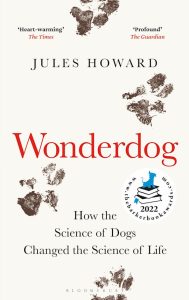
Reviewed by E. B. Heath
The history of human relationships with dogs, has been less than ideal. There are sections of this book that are hard to read. But it ends well. Most societies are beginning to adopt an empathetic approach to all of nature, including our most valuable of companions, the dog. Although, this is not routinely the case, there are still developed cultures that exploit animals most cruelly for little gain. (Bears caged for purpose of milking bile, animals being hunted to extinction for delusory medical cures.) In Wonderdog: How the Science of Dogs Changed the Science of Life, Jules Howard writes that this work is as much a story about humans as it is about dogs. And it certainly is. How humans have mis-treated defenceless animals in the name of science, or even generally in the broader community, suggests a lack of intelligence along with a sense of narcissistic superiority. Reports of scientific institutions in the past using dogs for exploratory research, without anaesthetic, watching the dog’s obvious extreme pain, and laughing! At this point it might have behoved the experimenters to turn their inquiring focus onto themselves.
But I digress … things have changed. Howard details the steps from the dark days of ignorance to the most recent discoveries. There is an extensive Index, also Research notes and further reading section.
Howard is a scientist and science is about objective proofs. In documenting the history of dog/human interactions Howard provides readers with the scientific research starting with Darwin and the Victorian era, how scientific experiments discovered the extent of a dogs sense of smell, touch and memory. Then to Pavlov and Skinner and the one-dimensional approach of conditioned response. Moving on to the mid-1900s where the disciplines of psychology, behavioural genetics, and neurobiology turned their attention to understanding animal intellect, emotions, feelings and cognition. Then he discusses modern-day research, leading to the first decades of this century in the final chapters. Here, at last, dogs are not considered objects of study but canine collaborators. Within this paradigm valuable knowledge has been uncovered about our constant, loving companions. Finally, and thankfully, it is discovered that dogs recognise themselves as individuals, and in the last twenty years knowledge has increased ten-fold as scientists have moved from: treating them like objects, then inmates, then patients and, finally, learning-companions, partners and something akin to metaphorical co-pilots.
Most interestingly, genetics has uncovered a sociable gene, GTF21RD1, a gene that is shared by humans and dogs alike. Other studies using fMRI machines have proved facts about dog emotions. To quote Howard:
That dogs feel love like we do is no longer an outlier’s opinion. That their hearts don’t beat like ours, that their brains don’t light up like ours, or that the warmth you give them is unlike the warmth they give back – opinions like these are now, after 150 years of scientific reasoning, drifting out of the mainstream.
Loving dogs owners who look their companions in the eye do not need proof that their friend is a very clever, loving being, that can be directed via pointing, and who can make requests using the same approach with their nose, and can sense the emotional state of the carer, so consequently, should be treated with much the same care as humans. Nevertheless, it nice to know that this is not just the opinion of dotty dog owners, rather it is scientific fact having been proved beyond doubt.
So what should be done with this new evidence. In the Epilogue, Howard briefly discusses a logical conclusion following this new evidence. He quotes an article written in The New York Times by scientist Gregory Berns suggesting dogs should have legal rights that would put to an end puppy farms and the cruelty of genetic inbreeding pursued in pedigree dog circles that causes them so much harm and suffering.
As Howard points out, it is essential to know the history of what has been done and discovered in order not to repeat ignorant unproductive behaviour. It might occur to readers that this information needs to be shared with a wider audience, perhaps incorporating it into the school science curriculum.
Highly Recommended
Wonderdog: How the Science of Dogs Changed the Science of Life
by Jules Howard
(2023)
Bloomsbury
Paperback
ISBN: 978 147298 422 7
$26.99; 288pp