Reviewed by Clare Brook
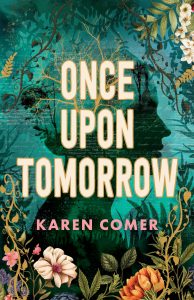
Three stories, about three girls, living in different times, woven together to form one novel for young adults. Such is Once Upon Tomorrow by Karen Comer, she skilfully illustrates social connection through time via tradition, textiles, and female agency. There is also a dystopian element that warns of a future controlled by corporations.
Miri living in 2015, is a talented student with ambitions to study psychology at university. Miri is in a long-term relationship with Jonah and becomes pregnant, so is faced with some difficult decisions. Jonah really wants the baby but is willing to support her in whatever she chooses to do. Miri does not want to compromise her or Jonah’s ambitions, and she is strongly encouraged by her father and stepmother to have an abortion. This novel discusses some gritty real-life scenarios.
In 2125 there has been a societal breakdown and in the aftermath a strong patriarchy has been re-established, so Aleita struggles in a world that does not respect female rights. It is in Aleita’s story that Comer imagines a dystopian world that embraces the use of AI implants for the benefit of advertising in a corporate run society. This acts as a warning for the current world as it grapples with the extent and speed of AI development, gathering momentum faster than predicted. Aleita also has a mystery to solve regarding her activist grandmother’s death.
The third strand of Comer’s novel is somewhat mystical using the genre of fairytale. Sylvie is the main character in this fairytale. She is the daughter of a humble Miller; her mysterious talents lead her to the court of the King and eventually she prevails and becomes his wife. Sylvie’s story appears in short chapters between the lives of Miri and Aleita. Comer has managed to insert the mystical nature of a fairytale illustrating how it transcends time. So doing Sylvie’s story is given relevance in the lives of Miri and Aleita.
To say this is an ambitious novel is somewhat of an understatement. I found the free verse a bit jarring at first but soon the style merged to enhance the message.
by Karen Comer
(2026)
Hachette Australia
Paperback
ISBN: 978 0 7344 2401 3
$19.99; 356pp
e-Book
ISBN: 978 0 7344 2402 0
$11.99