Reviewed by Ian Hamilton
This novel-memoir has smatterings of cultural references but the one that comes to mind, but not mentioned, is Frost’s poet “The Road Not Taken” because our protagonist’s story centres on his choices deliberate and choices fateful. I don’t think Frost ever wrote the complementary poem “The Road Taken” but the two ideas are inter-dependent, I think.
This book will delight anyone who thinks wistfully of Tuscany and the charming idiosyncrasies of the Italian people, especially those Tuscans blessed with a villa full of artifacts and their accompanying memories. The narrator – whom we will assume is a reliable narrator – is a twenty-something American with a recently completed degree in archival methods and purposes. He freely admits that he has had a narrow American education and this book about his time at Villa Coco has elements of the coming-of-age genre. He successfully applies for a temporary position as the archivist to the ninety-two-year-old Baronessa who owns Villa Coco. His name, we learn very late in the book, is Geoffrey but she sees him as her man Thursday, so modifies his name to Giovedí. She is a commanding woman, possibly of aristocratic status, and has clearly led a life of eccentric indulgence. Although Giovedí dines with her (the Villa has various staff members, including a cook), he is in many ways treated as a servant and he repeatedly refers to the Baronessa as his employer. In any case, she allocates him a wide range of tasks, until he is finally allowed to catalogue the artworks and curios that abound at the villa.
His completion of that task sets in motion the final events of the story, which take place in Venice. It is bad form for a review to reveal the denouement, so I won’t.
What can be revealed is that before we arrive at the end of the story, Greer has taken us into several sub-plots, each identified with the relationship between Giovedí and a member of the cast of characters. The story of the Baronessa and her influence on Giovedí is at the centre of the tale but other characters also shape his “before” and “after” world view. Most importantly is his attraction to, and eventual physical relationship with, the Baronessa’s handsome young cousin Giacomo-Giacomo. One possible road to take entails moving to Milan and living with him. Other formative influences are his education in all things Italian – led by the Nimali’s language lessons – and Oscar’s cultural tuition. Neighbours Estelle and Pullman also slip into and out of the languid action of this story. Pippa, an English aristocrat who claims to be a cousin of the Queen, adds faded glamour and has an important role in the final Venetian scenes.
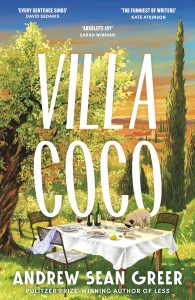
The style is guileless – hence my trust in the narrator. It is witty and charming. Matters such as the sexual relationship between Geoffrey and Giacomo-Giacomo are described with discretion and restraint. The contrast to works peppered with frequent vulgarity, especially in screenplays, is refreshing. While it is always wise caution to read the blurb quotations with some scepticism, as they arise from the youthful exuberance of the marketing department, in the case of this text, they are not misleading. A small sample: “Absolute Joy” (Sarah Winman); “Greer is not only the funniest of writers, but he has a wonderful way with conjuring an image … Villa Coco is such a sunny book.” (Kate Atkinson) and “Eccentric, funny, touching: I adored it” (Nina Stibbe).
In its own way this is a charmingly old-fashioned book. Its themes of life choices, self-understanding, integrity and affection are timeless.
Villa Coco
[2026]
by Andrew Sean Greer
Sceptre
ISBN: 978 1 3997 5729 4
$34.99; 269pp