Reviewed by Clare Brook
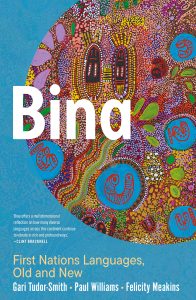
Indigenous linguists, Gari Tudor-Smith, Paul Williams and Felicity Meakins, give an account of the amazing diversity of Australian First Nations languages in Bina: First Nations Languages, Old and New. So doing they travelled throughout Australia studying fifty-six language groups. However, before colonisation there were over four hundred different languages, some as different as English is from Mandarin or Arabic.
First Nations people are routinely multi-lingual, speaking up to four different languages or more. However, bina is a word used across the continent holding similar meaning, all of which relate to language and the aural nature of knowledge. Language is not a static technology; it evolves through time. To quote April Campbell, an Anmatyerr educator: Language is like the desert flower … Because language won’t stay one place, it’s like, you know, wind blowing language to other communities …
In the Introduction the authors list the outcomes they wish to achieve, namely: to educate the general public on the worth and beauty of First Nations languages; to encourage language activists, educators, researchers and artists; to inform policy makers, educators and environmentalists about the important scientific and cultural knowledge contained in these languages; finally, to contribute to the mission of Truth-Telling and affirming the sovereignty of First Peoples of Australia. That is an ambitious set of goals for one book.
To aid navigation the authors usefully set out the subject matter in each set of chapters. Chapter 1 starts with the history of the impact of colonisation on language and health. Chapters 2 to 4 speak of remote communities who fought to retain their languages, and how the language holds cultural knowledge vital for survival. Chapter 5 details the birth of new languages, Kriol, Yumplatok, and English based Creoles. Chapter 6 gives the history of Aboriginal English dialects collectively spoken across the continent. And then the mixed languages such as Gurindji Kriol and Light Warlpiri and combinations of Kriol and Aboriginal English with traditional languages in Chapter 7. Chapters 8 to 11 chart the revival of languages through archival research.
How knowledge is embedded in Indigenous language is most interesting. It becomes clear that language is so much more than the spoken word; it carries cultural knowledge, provides a framework for how to understand the context in which we live, and in turn how language is influenced by that context. A brief example follows.
It might not be generally known that human brains have a geomagnetic sensory system utilising magnetite crystals. And, I don’t suppose the Gurindji people in the Northern Territory are aware of this either. Nevertheless, they are able to utilise this piece of brain technology because of their language!
Rather than using left and right for spatial direction Gurindji language constantly attends to geocentric cues, using precise compass points to describe spatial relationships for all objects and body positions, for example “put the flour north of the vegemite”. The Gurindji people must stay oriented just to be able to speak properly. And, no doubt, to stay alive in a hostile environment. Even a small child can point to any compass-point with complete accuracy, and without hesitation. Scientific tests have shown that they have a hardwired ability to detect the Earth’s magnetic field; apparently all humans had this ability at one time.
It is also discussed how Indigenous languages encode world views, incorporate really complicated social systems and family architecture. These kin structures are incorporated into the grammar of the language, examples are included.
Whereas many languages are extinct, Kriols, informed by Indigenous languages, act as a uniting force to keep culture alive.
It must be said that the British colonists destroyed much scientific knowledge by insisting on an English only approach to language. There is much to learn from First nations languages. And Bina is a good place to start, the above being a brief sample.
Bina: First Nations Languages, Old and New
by Gari Tudor-Smith, Paul Williams, Felicity Meakins
(2024)
La Trobe University Press
Paperback
ISBN: 978 176064 498 7
$37.99; 384pp